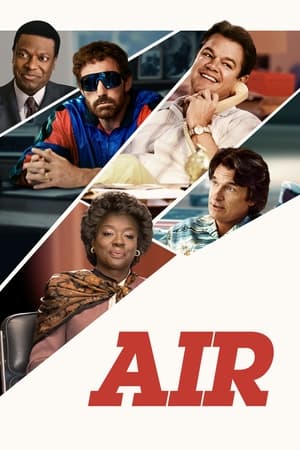
AIR(2023)
Written by: Alex Convery; Revisions by Ben Affleck and Matt Damon; Current Revisions by Ben Affleck, Matt Damon and Chris Tucker
Draft date: Not specified (pages reference revision dates of 05/31/22, 06/19/22, 07/01/22, and 07/08/22)
Genre: Drama
Title: Air
Written by: Alex Convery; Revisions by Ben Affleck and Matt Damon; Current Revisions by Ben Affleck, Matt Damon and Chris Tucker
Draft date: Not specified (pages reference revision dates of 05/31/22, 06/19/22, 07/01/22, and 07/08/22)
LOGLINE
In 1984, a passionate but embattled talent scout at Nike's struggling basketball division bets his career on signing a single unproven rookie — against the wishes of his CEO, the player's agent, and the player himself — by making an unprecedented pilgrimage to the athlete's family home in North Carolina and crafting a deal that will reshape the sneaker industry forever.
| Very Poor | Poor | Fair | Good | Excellent | |
|---|---|---|---|---|---|
| PREMISE | ✓ | ||||
| STRUCTURE | ✓ | ||||
| CHARACTER | ✓ | ||||
| CONFLICT | ✓ | ||||
| DIALOGUE | ✓ | ||||
| PACING | ✓ | ||||
| TONE | ✓ | ||||
| ORIGINALITY | ✓ | ||||
| LOGIC | ✓ | ||||
| CRAFT | ✓ |
| Strong Pass | Pass | Consider | Recommend | Strong Recommend | |
|---|---|---|---|---|---|
| Overall | ✓ |
Genre: Drama
Sub-genre: Sports Drama, Business Drama, Based on True Events
Keywords: Based on True Events, Underdog, Corporate Politics, Mentor-Protégé, Negotiation, 1980s Period, Sports Business, Male Protagonist, Ensemble Cast, Nike, Basketball, Endorsement Deal, Risk-Taking, Family, Race, American Dream
MPA Rating: R (pervasive strong language throughout, including frequent uses of "fuck" and sexually crude insults)
Budget Tier: Medium ($10M–$40M) — period-accurate 1984 settings across multiple U.S. and European locations, archival footage integration, licensing of multiple well-known songs, no significant VFX or action sequences but extensive location work and period production design required.
Pages: 107 (with significant formatting artifacts inflating page count; effective content is closer to 100 pages)
Time Period: 1984, over approximately 2-3 weeks, with epilogue title cards extending into the present.
Locations: Approximately 50% at Nike HQ in Beaverton, Oregon (modest 1984 office interiors, basement shoe lab, parking lot, hallways, conference rooms). 15% in Wilmington, North Carolina (Jordan family home exterior/backyard, rural highway driving). 10% in Las Vegas (sportsbook, craps table, convenience store). 10% at Converse HQ in North Reading, Massachusetts (conference room, exterior). 5% at Adidas HQ in Herzogenaurach, Germany (museum, conference room, monolithic exterior). Remaining 10% split among a Los Angeles restaurant, various car interiors, Phil Knight's home exterior, and a high school gym. Period vehicles, wardrobe, and technology (car phones, VHS tapes, beepers) required throughout.
Lead: Male, 45, white/Italian-American. Sonny Vaccaro is a rumpled, sleep-deprived talent scout with a gambler's instincts, relentless determination, and an abrasive candor that alienates colleagues but occasionally wins converts.
Comparables: Moneyball (2011) — underdog sports executive bets career on unconventional strategy against institutional resistance; Jerry Maguire (1996) — agent-athlete relationship drama centered on a high-stakes deal and personal conviction; The Social Network (2010) — fast-talking business negotiations and the origin story of a cultural institution; Ford v Ferrari (2019) — corporate mavericks fighting internal bureaucracy to achieve something transformative.
SYNOPSIS
A 1984 montage establishes the era before a Converse commercial featuring MAGIC JOHNSON, ISIAH THOMAS, and LARRY BIRD illustrates the sneaker giant's dominance. At Nike's unglamorous Beaverton, Oregon headquarters, SONNY VACCARO (45), head of Nike's basketball division talent scouting, walks with HOWARD WHITE (30s-40s), an African-American ex-athlete, discussing the challenges of selling basketball shoes for a company perceived as a jogging brand. White bluntly explains that black athletes and consumers see Nike as irrelevant to basketball culture.
In a strategy meeting, VP of Marketing ROB STRASSER (40s) leads a dispirited group through the NBA draft board, proposing to split their $250,000 budget across three or four mediocre prospects. Sonny demolishes each suggestion, humiliating colleagues who suggest safe picks like Melvin Turpin. Afterward, in the men's room, Strasser tells Sonny to stop berating people and start producing ideas. Sonny floats the name Michael Jordan, but Strasser insists Jordan is too expensive and wants Adidas. Sonny then meets with CEO and founder PHIL KNIGHT (40s), who warns that the basketball division nearly got cut entirely and refuses to increase spending. Phil questions Sonny's value to the company.
That night, Sonny watches game tape obsessively. An Arthur Ashe tennis commercial sparks an idea — what if a shoe could embody a single player's identity? He watches Jordan's championship-winning shot against Georgetown repeatedly and becomes convinced. He barges into Strasser's office the next morning, showing him the tape and arguing they should invest everything in Jordan alone, building an entire shoe line around him. Strasser is skeptical but intrigued.
Sonny calls Jordan's agent, DAVID FALK (40s), a razor-sharp power broker who tells Sonny that Jordan's sole directive is to sign with Adidas and that Nike is a "slow, fat stalking horse" at best. Falk warns that Adidas will offer at least $250,000 annually. Sonny has lunch with STU INMAN (50s), the Portland Trailblazers GM who passed on Jordan in the draft, probing Inman's reasoning and sensing the fear of a historic mistake. He also meets with GEORGE RAVELING (40s), the Olympic team coach, who confirms Jordan has no interest in Nike but tells Sonny a profound personal story about attending the March on Washington and receiving the original "I Have a Dream" speech manuscript — encouraging Sonny to trust his instinct even if it seems crazy.
Sonny pitches Phil on committing the entire budget to Jordan. Phil resists but doesn't shut it down completely. Sonny then flies uninvited to Wilmington, North Carolina, appearing at the Jordan family home. JAMES JORDAN (48) greets him cautiously. DELORIS JORDAN (43), Michael's shrewd and poised mother, initially chides Sonny's presumptuousness but invites him to sit. Sonny makes his case by predicting exactly what Converse and Adidas will say in their meetings and challenging Deloris to test his predictions. He tells her to ask Converse how Michael will stand out among their existing stars, and to ask Adidas who actually runs their company.
Back in Beaverton, Falk calls Sonny furious about the unauthorized visit but ultimately reveals that Deloris is making Michael attend a Nike meeting. Sonny enlists creative director PETER MOORE (49) to design a revolutionary shoe in days. Moore and Strasser develop the concept of paying NBA fines for violating the league's color rules, making the shoe's rebellious red-and-black design into a marketing asset. Moore names it "Air Jordan." Phil Knight, after going on a run, approves the full budget and the Jordan line.
The Converse meeting plays out exactly as Sonny predicted — executives pitch Jordan as joining Magic and Bird but cannot explain how he will stand out. The Adidas meeting reveals internal family dysfunction over leadership. At Nike's meeting, the team presents the Air Jordan prototype. Howard White connects warmly with the family. When a promotional video falls flat, Sonny abandons the script and delivers an impassioned speech directly to Jordan, predicting his future greatness, his championships, the cycles of fame and scrutiny, and the meaning a shoe can carry. Phil presents the offer.
After the meeting, Sonny learns Adidas has matched Nike's $250,000 offer and included a car. Devastated, he prepares for defeat — but Deloris calls personally. She accepts Nike's offer with one condition: Michael must receive a percentage of revenue from every shoe bearing his name. Sonny protests that such a deal is unprecedented and impossible. Deloris argues that Michael's talent will create the shoe's value, not the other way around, and that he deserves to be compensated accordingly. Sonny takes the demand to Phil, who agrees to the terms, telling Sonny, "You're remembered for the rules you break."
Sonny closes the deal. Title cards reveal that Air Jordan sold $162 million in its first year, now generates over $4 billion annually, and that Jordan has earned more than half a billion dollars a year in passive income from the arrangement. Epilogue cards note the fates of each principal: Phil retired after 51 years, Strasser left for Adidas and died at 46, Howard White became VP of Jordan Brand, Sonny was fired from Nike in 1991 and went on to help court Kobe Bryant for Adidas.
COMMENTS
PREMISE — Excellent
The premise — a middling corporate division gambles everything on one unproven athlete against institutional resistance, competitive rivals, and the athlete's own disinterest — contains inherent tension at every level: internal (Sonny versus his own company), external (Nike versus Converse and Adidas), and interpersonal (Sonny versus Falk, Sonny versus Deloris). The central dramatic question is not merely whether Jordan signs, since history answers that, but whether Sonny can convince everyone around him to take the leap. This shifts the engine from suspense about outcome to suspense about process and persuasion, which is the territory of Moneyball and The Social Network. The premise is enriched by its exploration of who creates value — the corporation or the individual — which gains resonance through Deloris Jordan's demand for revenue sharing. The setting of 1984 Nike, far from the behemoth it would become, grounds the underdog positioning credibly. The concept pitches cleanly: a shoe salesman nobody believes in bets his career that a rookie nobody wants to sign at his company will change sports forever.
STRUCTURE — Good
The narrative follows a clean linear progression with well-placed escalations. The pre-existing life and status quo occupy the first fifteen pages, establishing Nike's diminished basketball division and Sonny's frustrated position. The inciting moment arrives when Sonny watches Jordan's tape and has his epiphany (26-27), proportionally landing near 25% — slightly late for a catalyst but functioning as a combined catalyst and commitment beat, since Sonny immediately begins campaigning. The midpoint arrives with Sonny's unauthorized visit to the Jordan home (52-58), falling around page 55 of an effective 100-page runtime, which places it cleanly at the center. This visit transforms the dynamic from "can Sonny get a meeting" to "can Sonny close a deal." The Adidas match and apparent defeat (93-94) serves as the "all is lost" beat at roughly 88%, which is somewhat late — it compresses the resolution into a very tight window. The climax and resolution unfold rapidly across pages 94-101, with Deloris's phone call, her revenue-sharing demand, Phil's approval, and the closing all occurring in quick succession. Every scene advances the throughline, and subplots (Strasser's daughter, White's mentorship role, the Adidas family dysfunction) connect directly to the main negotiation. The one structural concern is that the promotional video in the Jordan meeting (88) exists solely to be abandoned so Sonny can deliver his speech — a somewhat mechanical setup, though the speech itself justifies the device.
CHARACTER — Good
Sonny is a fully realized protagonist with clear backstory (Pittsburgh steel-mill family, gambling tendencies), a defined want (sign Jordan), a flaw (recklessness that endangers colleagues' livelihoods), and an active approach throughout — he never waits for events to come to him. His arc is modest: he begins as a man who trusts his gut and ends as a man whose gut was proven right, which means he changes circumstances more than he changes internally. The most compelling character is Deloris Jordan, who enters at page 52 and dominates every scene she inhabits. Her final negotiation (94-99) is the dramatic peak, and her demand for revenue sharing reframes the entire narrative's thematic stakes. Strasser functions as conscience and emotional anchor, particularly in his monologue about his daughter (74), which provides the human cost Sonny's gamble carries. Phil Knight is sharply drawn as a philosophical capitalist who speaks in koans but ultimately acts on instinct (79, 100). Falk is an entertaining antagonist-ally whose verbal sparring with Sonny (27-35, 59-61) provides consistent energy. Howard White brings warmth and cultural specificity (4-10, 84-86). The ensemble is well-differentiated, though Michael Jordan himself is deliberately kept as an absence — never shown clearly, never given substantial dialogue until a single line at the end (101A). This is a bold choice that works thematically but means the person at the center of the transaction remains an abstraction.
CONFLICT — Good
The central conflict operates on multiple fronts simultaneously: Sonny against Phil Knight's fiscal conservatism (18-19, 36-37, 65-67), against Falk's gatekeeping (27-35, 40-41, 59-61), against Adidas and Converse as competitors (38-39, 68-69, 76-77), and against Jordan's own preference for Adidas. These layers ensure that obstacles arrive from different directions and escalate naturally. The internal conflict — Sonny's gambling nature versus the real-world consequences for people he cares about — surfaces most explicitly in Strasser's birthday-weekend confrontation (72-75), where Strasser articulates what Sonny stands to cost others. The late reversal when Adidas matches the offer (93) raises stakes effectively, but the resolution through Deloris's revenue-sharing demand (95-99) introduces a new conflict dimension (corporate precedent versus individual worth) that elevates what could have been a simple bidding war into something more substantive. Scene-level conflict is consistently present: nearly every conversation contains opposing positions, from the convenience store clerk's skepticism about Jordan's size (22-23) to Stu Inman's defensiveness about passing on Jordan (33-35).
DIALOGUE — Excellent
The dialogue is the material's most consistent strength, with distinct voices maintained across a large ensemble. Falk's rapid-fire aggression and baroque insults ("herpetic simplex 2 eruption on the sphincter of humanity," 60) are unmistakable and could not belong to any other character. Howard White's cadence — warm, anecdotal, rooted in specific cultural experience ("Black people don't jog," 6) — contrasts sharply with Phil Knight's clipped Buddhist aphorisms ("Self is a mirage," 66). Strasser occupies a middle register of corporate pragmatism laced with vulnerability, exemplified by his "Born in the USA" monologue (73-74) that reveals character through a seemingly tangential observation. Deloris Jordan speaks with measured precision that never slips into sentimentality, particularly in her final negotiation where she dismantles Sonny's objections with calm logic (96-99). Subtext operates effectively in the Phil-Sonny exchanges, where running becomes a recurring metaphor for commitment and philosophy (16-17, 48). The weakest dialogue belongs to the Converse and Adidas executives, who function as straw men — but this is by design, since Sonny has predicted their pitches verbatim.
PACING — Fair
The first act moves briskly, cycling through meetings and phone calls that establish the competitive landscape and Sonny's isolation within his own company. The middle section — from Sonny's decision to visit Wilmington through the preparation for the Nike meeting — maintains momentum through variety: the George Raveling lunch (42-46), the shoe design sessions (63-72), and the parallel Converse and Adidas meetings (68-69, 76-77) prevent the negotiation from becoming repetitive. The Nike presentation scene (83-91) is the dramatic centerpiece and earns its length through Sonny's extended speech, which builds from abandoning the scripted video to an emotionally charged monologue. The post-meeting section (92-101) is where pacing compresses most aggressively: the Adidas match, Deloris's call, the revenue-sharing negotiation, Phil's approval, and the closing all occur within approximately ten pages. This rush is noticeable but partially mitigated by the emotional weight of Deloris's argument. The interstitial driving scenes (49, 82, 92) function as breathing room but occasionally feel like padding rather than productive pauses.
TONE — Good
The tone balances corporate comedy with earnest sports drama, and the transitions between registers are handled with confidence. The men's room scene (9-11) and Falk's profane tirade (59-61) establish a comedic baseline that coexists comfortably with the more serious material — George Raveling's March on Washington anecdote (44-46), Strasser's confession about his daughter (74), Deloris's argument about the economics of being Black in America (99). The tonal risk is Sonny's climactic speech (89-91), which shifts from boardroom realism into something approaching prophecy, complete with intercut footage of Jordan's future achievements. This break from the established naturalistic register could feel jarring, but the speech is grounded in Sonny's established intensity and the material's thematic throughline about belief and vision. The Converse and Adidas scenes (68-69, 76-77) risk tipping into caricature — the competitors are made to look foolish rather than formidable — but these scenes are brief enough that the imbalance does not undermine the overall tonal architecture.
ORIGINALITY — Good
The business-negotiation-as-drama framework has clear precedents in Moneyball, The Social Network, and Jerry Maguire, and the underdog-corporate-maverick archetype is well-established. The execution distinguishes itself in two significant ways. First, the decision to never show Michael Jordan's face transforms the most famous athlete in history into an absence around which everyone else orbits — a conceptual choice that shifts attention from celebrity to the people who recognized potential before it was proven. Second, the late pivot to Deloris Jordan as the deal's true architect — not merely as a supporting figure but as the person who invents the revenue-sharing model that would reshape athlete compensation — gives the material a thematic dimension its comparables lack. The question of who owns the value an individual creates, articulated by a Black woman in 1984 North Carolina, resonates beyond sports business. Where the material is most conventional is in its sports-underdog structure: the scrappy outsider, the skeptical boss, the impossible deadline, the last-minute save. These beats are executed with polish but are not subverted.
LOGIC — Fair
The cause-and-effect chain is credible within the established world. Sonny's decision to visit the Jordans follows logically from Falk's refusal to arrange a meeting and Raveling's encouragement (44-46). Falk's about-face — agreeing to the Nike meeting after threatening Sonny's career (61) — is motivated by Deloris's insistence, which tracks with her established authority. Phil Knight's evolution from refusal (36-37) to grudging approval (79) to full commitment on the revenue share (100) follows a plausible arc of incremental persuasion. One structural logic question: Sonny's speech in the Nike meeting (89-91) includes specific predictions about Jordan's future that, within the diegetic reality, he could not know — championships, the father's death, retirement and return. The intercut future footage signals this is a dramatized, heightened moment rather than literal dialogue, but the text does not fully clarify whether these words are spoken aloud or represent an authorial flourish. This ambiguity is the most significant logic tension in the material. A minor convenience: Deloris calling Sonny directly rather than going through Falk (94) is acknowledged in dialogue but still requires accepting that Falk would tolerate being bypassed twice.
CRAFT — Good
The writing voice is energetic and confident, with character introductions that efficiently convey personality through behavioral detail rather than physical description — Phil Knight "doesn't look like a CEO, he looks like a long distance runner. A bohemian capitalist" (13), Falk "came out of the womb negotiating commission structures" (27). Action lines are economical but occasionally break the fourth wall with editorial commentary ("Some upscale bullshit restaurant," 32), which suits the irreverent tone but risks pulling attention to the authorial voice. The formatting carries artifacts from multiple revision passes — scene numbers, color-coded revision headers (Pink, Yellow, Blue), and OMITTED sluglines cluttering the read (19, 58-59). These are production-draft realities but impede clean evaluation. The recurring motif of the phrase "a shoe is just a shoe until somebody steps into it" appears first from Strasser (75) and then from Sonny (90-90A), creating effective thematic bookending. One notable formatting choice: Michael Jordan is introduced not through a character description but through accumulated references and the consistent refusal to show his face, which is handled through careful shot descriptions ("from OTS so Jordan is in soft focus," 83). This is sophisticated visual storytelling executed on the page.
OVERALL — Recommend
Air is a business drama about the 1984 deal that brought Michael Jordan to Nike, told through the perspective of the talent scout who staked his career on a player everyone else dismissed. Its greatest strength is dialogue — the exchanges between Sonny and Falk, Sonny and Phil, and especially Sonny and Deloris Jordan crackle with intelligence, humor, and thematic purpose (see: Dialogue, Character). The ensemble is well-constructed, with Howard White and Rob Strasser providing emotional and thematic counterweights to Sonny's single-mindedness. The weakest element is the compressed resolution: the final fifteen pages must accomplish the Adidas match, Deloris's revolutionary demand, Phil's capitulation, and the deal closing, leaving each beat less room than it deserves (see: Pacing, Structure). Sonny's climactic speech, while dramatically effective, operates in a different register than the rest of the material, flirting with omniscience that sits uneasily within the naturalistic framework (see: Logic, Tone). The decision to keep Jordan offscreen is the most distinctive creative choice and pays dividends thematically, though it also means the material's emotional core depends entirely on Sonny's conviction rather than any relationship with the person being pursued. The craft is polished, the premise pitches cleanly, and the thematic argument — that the people who create value deserve to share in it — is articulated with clarity and force through Deloris Jordan's negotiation, which elevates what could have been a conventional corporate underdog narrative into something more resonant.
Get this level of coverage for your screenplay
Every coverage includes 10 category ratings, an overall recommendation, and detailed analysis — powered by the same methodology used by talent agencies and literary managers.
Movie data provided by TMDB