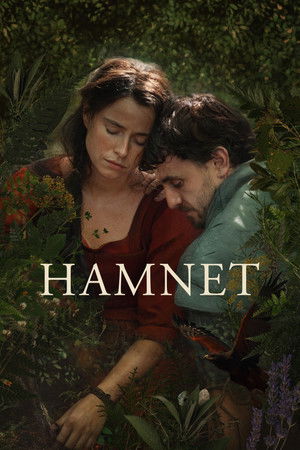
HAMNET(2025)
Written by: Chloé Zhao & Maggie O'Farrell
Draft date: October 2, 2024
Genre: Drama
Title: Hamnet
Written by: Chloé Zhao & Maggie O'Farrell
Draft date: Blue (and Final) shooting script: October 2, 2024
LOGLINE
In 1580s Stratford-upon-Avon, a wild, intuitive herbalist marries a restless Latin tutor and sends him to London to pursue his ambitions, only to face the devastating loss of their young son to plague — and years later, discovers that her absent husband has transmuted their shared grief into the most famous play ever written.
| Very Poor | Poor | Fair | Good | Excellent | |
|---|---|---|---|---|---|
| PREMISE | ✓ | ||||
| STRUCTURE | ✓ | ||||
| CHARACTER | ✓ | ||||
| CONFLICT | ✓ | ||||
| DIALOGUE | ✓ | ||||
| PACING | ✓ | ||||
| TONE | ✓ | ||||
| ORIGINALITY | ✓ | ||||
| LOGIC | ✓ | ||||
| CRAFT | ✓ |
| Strong Pass | Pass | Consider | Recommend | Strong Recommend | |
|---|---|---|---|---|---|
| Overall | ✓ |
Genre: Drama
Sub-genre: Period Drama, Biographical Drama, Romantic Drama
Keywords: Female Protagonist, Based on Novel, Elizabethan Era, Historical Figure, British Setting, Grief, Marriage, Motherhood, Loss of a Child, Plague, Shakespeare, Theatre, Herbalism, Nature, Family, Artist's Sacrifice, Twins, Faith/Spirituality
MPA Rating: R (childbirth sequences, implied sexuality, scenes of child death, emotional intensity, brief violence)
Budget Tier: High ($40M–$100M) — extensive period construction including a full-scale Globe Theatre, Elizabethan Stratford-upon-Avon, ancient forest locations, large cast with period costumes, live hawk handling, plague-era London, theatrical performance sequences requiring hundreds of extras
Pages: 118
Time Period: Approximately 1582–1601, spanning roughly 19 years, with flashbacks to approximately 1565 (30 years prior) and 1575 (17 years prior)
Locations: 60% rural Stratford-upon-Avon interiors and exteriors (Henley Street house with workshop/attic/kitchen/passageway, Hewlands farm, garden, fields, church), 20% ancient British forest (recurring ancient tree, paths, waterfall of roots), 15% Elizabethan London (Charterhouse courtyard and attic, River Thames, Globe Theatre interior/exterior/backstage), 5% miscellaneous (roads, river Avon). Requires period-accurate timber-framed houses, a functioning or built Globe Theatre interior with audience of hundreds, a forest location with massive ancient tree and root system, plague-era London streets with fire and death carts, live falconry, shadow puppet show, and staged Hamlet performance sequences.
Lead: Female, ages from approximately 18 to late 30s, white/English, physically strong and sunburnt with long dirty hair, an herbalist and falconer who is fiercely intuitive, emotionally raw, and deeply connected to the natural world — Agnes (the historical Anne Hathaway).
Comparables: The Piano (Jane Campion) for its portrayal of a woman's interior world expressed through sensory, non-verbal means in a period setting; Bright Star (Jane Campion) for its intimate focus on the domestic life surrounding a literary genius; Spencer for its subjective, almost supernatural rendering of a woman trapped by grief and institutional structures; The New World (Terrence Malick) for its lyrical treatment of nature as emotional landscape and cross-cultural romance.
SYNOPSIS
In an ancient British forest, a RED EGG rests among tree roots. WILL (late teens), a Latin tutor trapped paying his father's debts at the Hewlands farm, spots AGNES (early 20s), a sunburnt young woman with a hawk, crossing the field. He follows her into the garden, where their intense mutual attraction manifests immediately — she presses his hand to read him, then kisses him. She tells him her name is Agnes and abruptly refuses to see him again.
At Hewlands, JOAN (30s-40s), Agnes's stern stepmother, tends her own well-groomed daughters while needling Agnes about her wild habits. BARTHOLOMEW (late teens), Agnes's loyal younger brother, covers for her. At the Henley household, Will's father JOHN (40s), a violent glover, dominates the family. MARY (40s), Will's mother, warns him about the strange girl at Hewlands. Will returns to the forest, finds Agnes foraging, and notices she deliberately lets the hawk land on her bare hand to feel its claws. He gives her a new glove and confronts her self-harm. She tests him by asking for a story; he tells her Orpheus and Eurydice. She reads his hand, sensing vast unexplored landscapes within him. She treats his wound with herbal paste and they kiss deeply.
A flashback reveals Agnes's mother ROWAN, a forest-dwelling herbalist, teaching young Agnes and Bartholomew the Nine Herbs Charm. Rowan later dies in childbirth along with her stillborn child, a trauma young Agnes witnesses.
Back in the present, Agnes appears at the Henley house — pregnant with Will's child. Mary objects to the match, but John sees financial advantage. Bartholomew reluctantly consents. A hushed nighttime wedding follows. Agnes gives birth alone by the ancient tree; Will and Bartholomew find her with baby SUSANNA. Time passes. Will works miserably in the glove shop. Agnes detects a sour smell emanating from him — he is depressed, writing obsessively at night, destroying quills in rage. Agnes recognizes the landscapes she once saw in him are being crushed.
Agnes convinces Bartholomew to help send Will to London to expand John's business. Will departs, leaving Agnes heavily pregnant. During a flood, Agnes is forced to give birth in the Henley house instead of her beloved forest. She delivers twins: a boy and a girl. The girl appears lifeless but Agnes refuses to look away, and the baby revives. These are HAMNET and JUDITH (newborns).
Eleven years later, Hamnet and Judith (11) are playful twins who swap clothes to fool their family. Will, now successful in London, visits and rehearses lines from Macbeth with his children. Agnes's hawk dies and the family buries it. Will tells Hamnet he must return to London and asks the boy to be brave and look after his mother and sisters. Agnes and Will's marriage strains under his absence; she will not bring the children to London because Judith is sickly.
In London, Will witnesses plague horrors and a prophetic shadow puppet show. Back in Stratford, Hamnet finds Judith gravely ill with plague buboes. Agnes desperately nurses Judith through the night. At dawn, Hamnet crawls downstairs, sees his dying twin, and in a secret act of sacrifice, switches places with her on the pallet, willing Death to take him instead. Agnes wakes to find Judith recovering and Hamnet dying. Despite her frantic remedies — poultices, stones, salt, herbs — Hamnet dies in agony.
Agnes lays out her son's body alone, refusing help. Mary joins her in a tender midnight scene, revealing she once sought Rowan's help for her own sick children and tucking herbs into the shroud. Judith confesses Hamnet tricked Death. Will arrives too late, devastated. Agnes, consumed by guilt for not foreseeing the death, tells Will "you weren't here." He departs for London.
Months of grief pass. Will buys the largest house in Stratford but Agnes remains hollowed out, hearing phantom tapping in the walls, searching for her son everywhere. Will writes in his austere London attic. When Agnes confronts him, she reads his hand and sees nothing — her gift has gone dark. She tells him to return to London.
Joan arrives with a playbill for "Hamlet" — Will has used their son's name without telling Agnes. Furious and bewildered, Agnes travels to London with Bartholomew. They find Will's spartan room, then enter the Globe Theatre. Agnes watches the play unfold: she recognizes Will hidden as the Ghost, hears her son's name spoken by strangers, sees Ophelia distributing herbs like a mirror of herself, and watches young Hamlet fence as her son once dreamed. During the Ghost scene, Will looks directly at Agnes from the stage. In the side wing afterward, Will's protective shell shatters and he weeps.
During "To be, or not to be," the perspective shifts to Hamnet's — the boy has been waiting at the threshold of the Globe, the temple his father built, for his mother to find him and let him go. Agnes feels his presence, whispers his name, and watches as Hamnet smiles, turns, and walks into the void. She weeps with heartbreak, surrender, and acceptance. In the forest, the red egg cracks — a sign of rebirth.
COMMENTS
PREMISE — Excellent
The premise inverts the conventional biographical portrait of Shakespeare by centering his wife as the protagonist and reframing the creation of Hamlet as an act born from shared parental grief rather than solitary genius. This repositioning generates inherent tension: the very quality that makes Agnes fall in love with Will — his vast interior landscape — is what pulls him away from her and their children. The central dramatic question is not whether Shakespeare will write his masterpiece but whether Agnes can survive the cost of having enabled it, and whether the art itself can serve as a bridge back to the person she lost. The Elizabethan setting provides rich ground for exploring a woman whose herbal knowledge and intuitive gifts place her outside institutional power, making her simultaneously essential and marginal. The thematic through-line — that grief, like a tree's scar, requires time and openness to heal properly — is woven into every element from Rowan's early teaching to the final image of the cracking egg. Comparable territory includes Bright Star, which similarly domesticates literary mythology, and The Piano, which channels a woman's suppressed interior life through non-verbal expression, though this premise carries the additional structural ambition of building toward a real theatrical performance as its climax.
STRUCTURE — Good
The narrative moves chronologically through roughly nineteen years with strategic flashbacks, and its proportional beats land with precision. The inciting incident — Agnes and Will's charged first meeting — arrives immediately (4–6), establishing the central relationship by page 10. The commitment to the marriage and its consequences occupies pages 22–32, functioning as a clear break into the central conflict at roughly the 25% mark. Will's departure for London around page 44 serves as a strong midpoint pivot, shifting the dramatic engine from courtship and domesticity to absence and deterioration. Hamnet's death at page 76 — approximately 64% — functions as the catastrophic turn, and the proportional distance between this event and the climax inside the Globe (pages 103–118) provides necessary space for Agnes's grief to deepen before her journey to London. The climax itself is structural innovation: the performance of Hamlet becomes the resolution mechanism, with Agnes watching the play as both audience and participant. Every major subplot — Rowan's death, the hawk's significance, Will's self-harm, Judith's fragility — pays off within the Globe sequence. The one structural risk is the extended theatrical performance (pages 103–118), which spans fifteen pages of largely pre-existing Shakespeare text. While each excerpt is carefully chosen to mirror Agnes's experience, the dramatic momentum relies heavily on cross-cutting between Agnes's reactions and the stage action, which on the page reads as somewhat static compared to the propulsive first two-thirds.
CHARACTER — Good
Agnes is a fully realized protagonist whose arc moves through five clear beats: her backstory as a motherless child of a forest healer (49–51), her want to love and be loved without constraint, her internal need to relinquish control over what she cannot foresee, her active choices to marry Will and send him to London, and her painful transformation from a woman who sees everything to one who sees nothing (96) before arriving at acceptance (118). The supporting cast serves distinct dramatic functions — Bartholomew as conscience and protector (30–31, 43), Mary as the unexpected mother-surrogate whose midnight herbal offering (78–80) is the most surprising character turn in the material, and Joan as the institutional counterweight to Agnes's wildness. Will is compelling but deliberately kept at greater distance; his arc from caged animal to absent artist to broken father unfolds more through Agnes's perception than through direct interiority, which is the correct choice for the material but means his suicidal moment at the dock (91–92) arrives with slightly less earned weight than it might, given that his London life is rendered in relatively few scenes. Hamnet himself, despite limited page time, achieves remarkable presence through the clothes-swapping sequence (53) and his sacrificial act (70–72), which gives the character mythic dimension.
CONFLICT — Good
The main external conflict — Agnes's struggle to hold her family together while her husband pursues his vocation in London — is formidable because it is built on irreconcilable goods: Will's art requires distance, and Agnes's family requires presence. This conflict escalates methodically, from the early tension of Will's depression in the glove shop (38–40), through the wrenching departure scene (44–45), to Hamnet's death during Will's absence (76), to the devastating confrontation where Agnes reads Will's hand and finds nothing (96). The internal conflict is equally well-defined: Agnes's gift of perception, inherited from her mother, is both her greatest strength and the source of her deepest guilt — she foresaw danger for Judith but was blind to Hamnet's fate (82–83). The scene-level conflict is strongest in the domestic sequences, particularly the dinner at the Henley house (10–12) where John's violence erupts with startling efficiency, and the birth sequence (46–52) where Agnes fights against delivering in the house she fears. The final act shifts conflict from interpersonal to internal-spiritual: Agnes must decide whether the play that uses her son's name is an act of betrayal or of love, and this question drives the Globe sequence with genuine suspense.
DIALOGUE — Good
The dialogue achieves distinctive voices for its principal characters while maintaining period-appropriate diction without becoming archaic. Agnes speaks in sensory, concrete terms rooted in the natural world — "The branches are so dense. You cannot feel the rain" (32) — while Will's speech patterns shift between clipped domestic exchanges and lyrical flights, reflecting his dual nature. The most effective dialogue occurs in scenes of subtext: Agnes's "I choose you" during the apple shed scene (25) carries the weight of her entire backstory, and Judith's question "What is the word for someone who was a twin but is no longer a twin?" (85) is devastating in its simplicity. Mary's voice is particularly well-differentiated — practical, guarded, but capable of surprising warmth, as when she names the specific herbs to exclude from the shroud: "No heartsease. Hamnet dislikes the smell" (79). The weakest dialogue occurs in the flashback village women sequences (51, 77), where the choral exposition — "There was nothing to be done...Midwife did her best" — reads as functional rather than organic. Agnes's stream-of-consciousness during the twin birth (47–48) effectively blurs the line between delirium and prophecy.
PACING — Fair
The first sixty pages move with controlled urgency, compressing courtship, marriage, and the birth of three children without feeling rushed, largely because each time jump is anchored by a specific sensory or emotional detail — the smell of Will's depression (36–37), the hawk burial (57). The middle section slows appropriately to establish the rhythms of domestic life and Will's absence, though the stretch between Will's departure (page 44) and Hamnet's illness (page 66) covers significant time with relatively few dramatic events, relying on mood and accumulation rather than incident. The death sequence (66–82) is masterfully paced, with the agonizing night vigil, Hamnet's secret switch, and the morning discovery creating unbearable tension across sixteen pages. The post-death grief section (82–97) risks dragging, but each scene introduces a necessary new dimension — Judith's guilt, Will's suicidal edge, the marital confrontation. The Globe sequence (103–118) is the boldest pacing choice: fifteen pages of theatrical performance that function as emotional climax. On the page, the alternation between Shakespeare's text and Agnes's reactions sustains engagement, though the sheer volume of quoted verse may test patience for readers unfamiliar with Hamlet.
TONE — Good
The tonal register is consistent throughout — elegiac, sensory, grounded in the physical world even at its most mystical. The supernatural elements (Agnes's hand-reading, the recurring void, Hamnet's liminal wandering of the Globe) are presented not as genre departures but as extensions of the material's animistic worldview, established from the opening forest sequence (2) and Rowan's teachings (25–26). The shadow puppet show in London (63–65) is the most tonally daring insert, functioning as a plague-era folk art that mirrors the narrative's themes without breaking the period texture. The apple shed sex scene (23–25) balances eroticism with emotional vulnerability in a way that honors both characters' damage, and the birth sequences (34–35, 46–52) present physical extremity without tipping into horror. The one tonal wobble is the "Option to Play" notations (30, 56, 113–114), which are artifacts of the shooting script format but interrupt the reading experience by introducing uncertainty about what is actually in the film.
ORIGINALITY — Good
While biographical drama about Shakespeare's domestic life has precedent — Shakespeare in Love treated similar territory as romantic comedy, and All Is True examined his late-life return to Stratford — this material distinguishes itself fundamentally by making Agnes the protagonist and by using the creation of Hamlet not as a backdrop but as the dramatic resolution. The structural conceit of building toward the Globe performance, where Agnes watches her grief reflected back through her husband's art, is genuinely inventive and has no close equivalent in period literary biography. The treatment of Agnes's herbal knowledge and hand-reading as a coherent spiritual system rather than a quaint period detail gives the material a dimension absent from comparable films. The recurring void motif — appearing in the forest, the Henley passageway, the Globe backdrop, and finally as the space Hamnet walks into — creates a visual and thematic architecture more commonly associated with art cinema than with historical drama. The shadow puppet sequence anticipates and mirrors the Globe climax in miniature, a structural rhyme that demonstrates genuine craft in the execution beyond the premise.
LOGIC — Good
The internal logic is carefully maintained, particularly regarding Agnes's gift: she can read people through touch but is explicitly shown to be fallible — she foresees two children at her deathbed (45) but misinterprets this as her own children rather than Mary and the midwife (49–50), and her inability to dream during pregnancy (45) establishes that her perception has limits. Hamnet's sacrificial switch (70–72) operates within the material's established supernatural framework — Death as a presence that can be confused — without requiring literal belief. The timeline is mostly clean, though the transition between Will's departure for London and the twin birth compresses what should be months into a sequence that feels more immediate (44–52). One minor inconsistency: Agnes tells Will she will have "two children at my deathbed" (45), but she has three children, and while the line is later recontextualized during the twin birth, the prophecy's mechanics remain somewhat ambiguous. The question of how Joan obtained the Hamlet playbill before Agnes (99–100) is adequately explained by Joan's cousin visiting from London, though Agnes's complete ignorance of her husband's most famous work requires accepting that Will has essentially ceased all communication — a state supported by the text but worth noting.
CRAFT — Good
The writing operates at the literary end of the spectrum, with action descriptions that read as prose poetry — "Her hair is long and dirty. Her cheeks sunburnt. She wears a worn dress in dark red, like a fresh organ" (2) — and this approach is effective because the material's concerns are sensory and emotional rather than plot-driven. Character introductions are vivid and economical: John is established entirely through "his face in the shadows" and his relationship to leather work (10), and Rowan through her kitchen "as wild as the forest" (25). The recurring motifs — the red egg, the void, the Nine Herbs Charm, the iambic pentameter heartbeat — are planted and developed with novelistic care. Formatting includes several "OPTION TO PLAY" and "OMITTED" notations (30, 50, 54, 67–69, 95, 113) that are standard for shooting drafts but create gaps in the reading experience. Minor errors appear: "descent" for "descend" (2), "find" for "mind" (13), "restraint" for "restrain" (2), and "siting" for "citing" (20). The stage directions occasionally address the camera or audience directly — "We realize we are him" (117) — which is unconventional but consistent with the material's investment in dissolving boundaries between observer and observed.
OVERALL — Recommend
Hamnet is an elegiac period drama that reimagines the domestic life behind Shakespeare's most famous play, centering his wife Agnes as a woman whose intuitive gifts could not prevent the loss of her son and whose journey to the Globe Theatre becomes an act of both confrontation and release. The strongest elements are Character and Premise: Agnes is a richly drawn protagonist whose arc from open-hearted wildness through sealed grief to reluctant acceptance is tracked with novelistic specificity, and the premise's structural ambition — building an entire biographical drama toward a theatrical performance that serves as emotional climax — is both original and earned. The Craft is distinctive and assured, with prose-poetry descriptions that honor the material's sensory concerns. The primary weakness is Pacing in the final third, where the extended Globe sequence asks the reader to sustain engagement through fifteen pages of staged Shakespeare, a gamble that depends heavily on directorial execution to land with the cumulative force the material clearly intends. The post-death grief section between pages 82 and 100 also tests patience, though each scene contributes something necessary. The Dialogue is strong throughout, with Mary's midnight herbal scene standing out as the most surprising and moving exchange. This is ambitious, emotionally serious material with a clear directorial vision encoded into its pages, and its challenges are primarily ones of execution rather than conception.
Get this level of coverage for your screenplay
Every coverage includes 10 category ratings, an overall recommendation, and detailed analysis — powered by the same methodology used by talent agencies and literary managers.
Movie data provided by TMDB