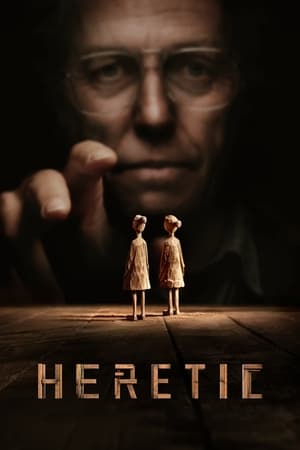
HERETIC(2024)
Written by: Scott Beck & Bryan Woods
Genre: Horror
Title: Heretic
Written by: Scott Beck & Bryan Woods
Draft date: Not specified
LOGLINE
Two young Mormon missionaries visit a middle-aged man's home for a routine conversion appointment, only to find themselves trapped inside his labyrinthine house as he systematically dismantles their faith and reveals an increasingly sinister agenda involving captive women, staged miracles, and a theory about religion as a mechanism of control.
| Very Poor | Poor | Fair | Good | Excellent | |
|---|---|---|---|---|---|
| PREMISE | ✓ | ||||
| STRUCTURE | ✓ | ||||
| CHARACTER | ✓ | ||||
| CONFLICT | ✓ | ||||
| DIALOGUE | ✓ | ||||
| PACING | ✓ | ||||
| TONE | ✓ | ||||
| ORIGINALITY | ✓ | ||||
| LOGIC | ✓ | ||||
| CRAFT | ✓ |
| Strong Pass | Pass | Consider | Recommend | Strong Recommend | |
|---|---|---|---|---|---|
| Overall | ✓ |
Genre: Thriller, Horror
Sub-genre: Psychological Thriller, Religious Horror, Contained Thriller
Keywords: Female Protagonist, Religion, Faith/Spirituality, Trapped, Cat-and-Mouse, Cult, Debate, Mormon, Philosophical, Manipulation, Two-Hander, Contained Location, Survival
MPA Rating: R (graphic violence, disturbing images, sustained menace, moderate language)
Budget Tier: Low ($1M–$10M) — primarily a single-location contained thriller with a small cast, minimal VFX, and no period requirements; the house interior requires multiple practical rooms including a basement, tunnel system, and hidden chambers.
Pages: 123
Time Period: Present, over approximately 4-5 hours in a single evening.
Locations: 90% interior of a small, labyrinthine house in suburban Peoria, Illinois — requires a living room, library with altar and colored doors, basement, underground tunnel system with color-coded chambers, a study, and stairwells connecting them (practically demanding a purpose-built set or heavily modified location). 5% exterior suburban streets and a park bench. 5% interior of a Mormon church building. Storm conditions required for all exterior scenes.
Lead: Two female leads — SISTER PAXTON (19), white, bubbly and sheltered but ultimately resourceful; SISTER BARNES (20), white, intelligent and edgy, harboring private doubts about her faith. The antagonist MR. REED (50s), white, outwardly ordinary with a kind voice masking a complex and dangerous intellect.
Comparables: 10 Cloverfield Lane (contained thriller with a charismatic captor and escalating psychological tension in a bunker setting), The Invitation (a dinner party that gradually reveals sinister intentions through philosophical conversation), Get Out (social horror where polite normalcy masks predatory intent), Misery (single-location captivity thriller with intellectual cat-and-mouse dynamics).
SYNOPSIS
SISTER PAXTON (19), a bubbly but sheltered Mormon missionary, and SISTER BARNES (20), her intelligent and edgy companion, sit on a park bench in Peoria, Illinois, killing time before an appointment. They discuss condoms, pornography, and divine confirmation with endearing awkwardness. A text arrives: their investigator is running late. Despite a warning from SISTER HALL that the man isn't interested, Paxton insists on visiting — she hasn't baptized anyone on her mission and wants the achievement.
The sisters walk through the neighborhood, enduring a sorority girl who publicly humiliates Paxton by pulling down her skirt to reveal her Mormon undergarments. Barnes consoles her companion as they reach a rusted gate, where Barnes locks their bicycles with a red U-lock and pockets the key. They approach a small house surrounded by religious paraphernalia.
MR. REED (50s), an ordinary-looking man with a kind voice, welcomes them inside after confirming his wife is home — a requirement for the missionaries' safety. The living room is barren, the windows unusually small. Reed mentions the walls and ceiling contain metal. He serves Coke, lights a blueberry-scented candle, and engages the sisters in theological conversation, quoting David Foster Wallace and probing their beliefs about polygamy, Joseph Smith's possible manipulation of revelation, and the reliability of religious truth filtered through flawed men. Barnes engages intellectually while Paxton remains faithful. Reed then blows out the candle and announces he has discovered "the one True Religion."
Meanwhile, ELDER KENNEDY (50), the mission president at the local Mormon church, notices the sisters are overdue for their cleaning assignment and grows concerned.
The sisters attempt to leave but discover the front door is locked — Reed explains the deadbolts operate on a timer. He directs them to exit through two doors in his library, one yellow and one purple. Reed escalates his challenge, asking the sisters to consider whether they believe his wife exists despite mounting evidence she does not, drawing a parallel to their faith in God. He labels the yellow door "Belief" and the purple door "Disbelief," demanding they choose based on their faith. Barnes deduces both doors lead to the same basement and calls out Reed's manipulation. The sisters choose the yellow "Belief" door and descend into darkness.
In the pitch-black basement, they find an empty cinder-block room with a card table. Through a speaking tube, Reed introduces a frail, veiled woman he calls "the Prophet" — formerly referenced as MRS. REED — a skeletal, blue-skinned figure who eats poisoned blueberry pie, dies, and then apparently resurrects, delivering a cryptic prophecy about darkness, a conductor, and reality not being real.
Elder Kennedy arrives at Reed's door. The sisters scream but the soundproofed walls muffle them. Reed turns Kennedy away twice, and the Elder departs without discovering them. The sisters use the distraction to pull a carpet runner under a door to retrieve matches, and Barnes hides a stolen letter opener in Paxton's coat with the code word "Magic Underwear" to signal an attack.
Reed returns to the basement, kills Barnes with a box cutter before Paxton can act, then attempts to frame the death as another resurrection experiment. When Barnes does not revive, Reed cuts into her arm and extracts a contraceptive implant, claiming it is a microchip proving Barnes was a simulated "non-playable character." He presents an elaborate simulation hypothesis — that reality is artificial, death is the gateway to the real world, and the Prophet's visions confirm this.
Paxton, now alone, challenges Reed's theory. She argues the Prophet's bodies were switched during the doorbell distraction, and discovers a hidden trapdoor in the basement floor. Descending through a crude tunnel, she passes through color-coded chambers of various religious and philosophical texts before finding a door locked with their own red bicycle U-lock. Using the bike key Reed had planted in her coat, she opens it to discover six old women imprisoned in dog cages — Reed's collection of "prophets." Reed reveals his thesis: the one true religion is control, and religion is a system created by men to manipulate.
Paxton stabs Reed in the neck with the letter opener when he says the code word "magic underwear." She flees through the tunnel system but discovers the house is designed as a Möbius strip with no exit. Reed, wounded but alive, stabs her in the stomach. As Reed crawls toward Paxton to finish her, Barnes — barely alive — strikes Reed with a nail-studded floorboard, killing him, then dies in Paxton's arms. Paxton uses a scale model of the house in Reed's study to find a hidden air duct and escapes at dawn. As she calls 911, a butterfly lands on her fingertip — echoing Paxton's earlier wish to return as a butterfly to comfort loved ones.
COMMENTS
PREMISE — Excellent
The premise is a contained-location theological debate that escalates into survival horror — two young Mormon missionaries trapped in a zealot's labyrinthine house as he attempts to deconstruct their faith and prove his own dark thesis about religion as control. The concept is inherently rich because it weaponizes the missionaries' own door-knocking ritual against them: the people who enter strangers' homes to sell ideas become captives of a stranger selling his own. Reed's intellectual sophistication makes him a formidable antagonist whose menace operates through persuasion rather than brute force, which distinguishes the material from standard home-invasion fare like Don't Breathe or 10 Cloverfield Lane. The central dramatic question — can faith survive when its foundations are systematically dismantled? — gives the horror genuine philosophical stakes. The premise also builds in a ticking clock (Elder Kennedy's search), clear rules (the missionaries' safety protocols), and an inherent power asymmetry that generates tension from the first moment Reed opens his door. The setting of a Möbius-strip house literalizes the trap of circular reasoning, a genuinely clever conceptual marriage of form and theme.
STRUCTURE — Good
The first thirty pages function as an extended setup that earns its length through escalating social discomfort — the park bench conversation, the sorority girl humiliation, and the initial pleasantries with Reed all establish character and stakes before the trap closes. The inciting incident lands around page 31 when the front door refuses to open, proportionally appropriate at roughly 25% of the page count. The midpoint arrives with the Prophet's death-and-resurrection sequence (pages 76–82), which reframes the conflict from "can we escape?" to "what is actually happening here?" — a genuine paradigm shift. Barnes's murder (98) serves as the break into the final movement at approximately 80%, which runs slightly late but works because the preceding scene builds to it with agonizing inevitability. The climax lands near page 121 with Barnes's last-breath rescue. The Möbius-strip revelation (119) is structurally elegant, as every apparent path forward loops back into captivity, making Paxton's eventual escape through the model house feel earned rather than convenient. One structural concern: the extended Kennedy doorbell sequence (84–88) risks deflating momentum by introducing and then removing hope in a pattern that, while thematically purposeful, stretches across several pages without advancing the protagonist's position.
CHARACTER — Good
Paxton and Barnes are sharply differentiated from their first exchange — Paxton's verbal clumsiness and earnest faith against Barnes's quiet doubt and intellectual sharpness (2–6). Barnes carries the stronger arc through the middle sections, her private skepticism surfacing in hesitations that Reed exploits (22–23), while her decisive leadership in the basement (68–70) reveals genuine courage. Her death at page 98 is devastating precisely because she has been the competent one, forcing Paxton to become the protagonist she never expected to be. Paxton's transformation from the sister who stumbles over the word "pornography" to the one who outmaneuvers Reed's logic (107–112) and delivers the code-word strike (118) is the material's most satisfying arc. Reed is compelling as a villain whose intelligence is genuinely threatening — his Monopoly-to-religion analogy (47–54) demonstrates a mind that has rehearsed this encounter obsessively. The Prophet functions more as a mechanism than a character, which is appropriate given her role. Elder Kennedy, however, is too easily dispatched (84–88) — his failure to investigate further strains the credibility of a man established as meticulous about details (27–29).
CONFLICT — Good
The central conflict operates on two simultaneous planes: physical captivity and intellectual siege. The external threat — escape from a house designed as a sealed loop — escalates methodically from a stuck door (31) to revealed basements (43) to underground tunnels (112) to the Möbius revelation (119). The internal conflict is more nuanced: Barnes must decide whether engaging Reed's arguments honestly endangers them or keeps them alive, while Paxton must determine whether her faith is a liability or her greatest asset. Reed's claim that "the one true religion is control" (116) reframes every preceding moment as evidence for his thesis, which gives the conflict retroactive depth. The scene-level conflict is consistently strong — nearly every exchange contains competing objectives. The weakest conflict beat is the Prophet resurrection sequence (76–82), where the girls are reduced to passive witnesses for an extended stretch, responding to Reed's commands ("Acknowledge") without agency. This passivity is narratively logical but creates a dip in dramatic energy at a critical juncture.
DIALOGUE — Good
The dialogue is the material's most distinctive asset, functioning as both characterization and weapon. Reed's speech patterns — the professorial digressions, the false warmth of "have a seat, have a seat" (13), the sudden pivots from fast food to theology (24–25) — create a voice that is chilling precisely because it sounds reasonable. The fast-food ranking sequence (23–24) is a masterclass in using apparently trivial conversation to establish character dynamics and then pivot into thematic payload. Paxton and Barnes sound authentically young and Mormon-specific — the stammered "porno-ography" (3), the substitution of "shiz" and "bishes" for profanity (4, 9), and the repeated "choose the right" callback (63) all ring true. The code-word payoff with "Magic Underwear" (118) lands because the phrase has been seeded through the humiliation scene (7) and the earlier conversation, making it both a tactical device and a thematic reclamation. One weakness: Reed's extended monologues in the simulation theory section (102–106) begin to read as lecture rather than dialogue, with Paxton reduced to single-line prompts that feel more like a podcast interview than a dramatic exchange.
PACING — Fair
The first forty pages demonstrate exceptional pacing discipline — what could feel slow is propelled by constant micro-escalations in social discomfort: the condom ad (2), the skirt-pulling (8), the absent wife (13), the locked door (31). The middle section bogs slightly during Reed's extended theological presentations (47–60), where the intellectual content, while fascinating, requires the girls to stand and listen for sustained stretches with limited physical action. The Kennedy doorbell sequence (84–88) provides needed relief but then the material spends pages 96–107 in another extended Reed monologue about simulation theory that taxes forward momentum. The tunnel sequence (112–114) injects urgent kinetic energy at exactly the right moment, and the Möbius reveal through the final confrontation (119–122) moves at breakneck speed. The butterfly ending (123) provides a brief, effective coda, though the transition from visceral violence to quiet grace is abrupt.
TONE — Fair
The tonal management is sophisticated, blending social comedy, intellectual thriller, and body horror without the seams showing — until the final third. The opening park bench scene (2–4) establishes a comic register that makes the later horror feel more violating by contrast. The shift from awkward comedy to genuine menace is gradual and controlled, pivoting around Reed's "the one True Religion" speech (25) where his voice acquires "a darkness." The Prophet's introduction (71–76) marks a decisive tonal break into horror that is earned by the preceding tension. Where the tone falters is in the simulation theory section (102–106), which veers into speculative science fiction in a way that feels like a genre departure from the grounded psychological horror that precedes it. The insertion of pop-culture references — Jar Jar Binks (59), Call of Duty, Yogurtland (76) — occasionally undermines moments of dread with levity that feels authorial rather than character-driven.
ORIGINALITY — Good
The premise occupies territory adjacent to 10 Cloverfield Lane (charismatic captor, contained space, escalating revelations) and The Invitation (social gathering as philosophical trap), but the specific intersection of Mormon missionary culture and academic theology-as-weapon is genuinely novel. No widely known film uses door-to-door evangelism as the entry point for a horror premise in this way. The Monopoly-to-religion iterative framework (47–54) is a fresh structural device for expressing theological argument through thriller mechanics. The execution innovates most in its second act, where the colored doors and Möbius-strip architecture literalize philosophical concepts. The simulation hypothesis turn in the final third, however, borrows heavily from well-established territory — The Matrix, eXistenZ, and countless Black Mirror episodes — and feels less original than the theological material that precedes it. The most genuinely surprising element is the code-word payoff and the structural reveal that Reed planted the bike key to ensure Paxton's exact path (115), which transforms the entire narrative into evidence for Reed's thesis in a way that no comparable film achieves.
LOGIC — Fair
The internal logic is impressively tight for most of the runtime — the metal walls blocking cell signals (39), the timer-locked front door (84), and the bike key switcheroo (115) all follow rules established in advance. The house's architecture as a sealed loop is supported by the scale model revelation (122), which retroactively justifies the spatial relationships. Two significant logic concerns emerge: first, Barnes surviving her throat wound long enough to climb stairs and deliver a killing blow (121–122) strains medical plausibility, even accounting for adrenaline — the wound is described as "gaping" (98) and she has been bleeding for at least twenty minutes of narrative time. Second, Reed's ability to appear in the black chamber ahead of Paxton (114) after she has been traveling through the tunnel system requires him to have navigated a separate route while bleeding from a neck wound, which is possible given the hidden passages but is never explained. The Prophet's resurrection mechanism — body-switching during the doorbell distraction — is satisfyingly logical, but the logistics of moving a corpse through a hidden door while the girls are in the adjacent stairwell (83–88) demand precise choreography that the text acknowledges only implicitly.
CRAFT — Good
The writing demonstrates a confident command of visual storytelling and reader manipulation. Character introductions are efficient and memorable — Reed's "ordinary features disguise a complex intellect" (9) tells precisely what a casting director needs. The use of physical space as a narrative device — the slowly rising red curtain (49–50), the water pooling toward the trapdoor (110–111) — shows cinematic thinking translated effectively to the page. The formatting is occasionally unconventional but purposeful: the vertical spacing of the Prophet's prophecy (91), the extended ellipses during the resurrection wait (81–82), and the ALL CAPS violence sequences (98, 118) all serve pacing on the page. The script employs metatheatrical asides — "We may even hear the uncomfortable shifting of audience members" (25), "For attentive viewers" (50) — that break the fourth wall in ways that work as tonal signals but technically violate the screenplay-as-blueprint convention. Action lines are generally lean, though the simulation theory section (102–106) becomes text-heavy with exposition that could benefit from more visual dramatization. A minor error: "DISBELIeF" appears with a lowercase "e" (62), likely a typo.
OVERALL — Recommend
Heretic is a contained psychological thriller in which two Mormon missionaries are trapped in a zealot's architecturally impossible house as he attempts to deconstruct their faith and prove that religion is merely a system of male control. The material's greatest strengths are its dialogue — which manages to be simultaneously funny, unnerving, and philosophically substantive — and its structural ingenuity, particularly the Möbius-strip house design and the retroactive revelation that every apparent choice was predetermined. Paxton's character arc from stammering naïveté to lethal resourcefulness is deeply satisfying, and Reed is a villain whose intelligence makes him genuinely frightening rather than merely menacing. The weakest elements cluster in the final third: the simulation hypothesis detour dilutes the more grounded theological horror that precedes it, the extended monologues reduce Paxton to a passive listener at moments that demand her agency, and Barnes's physically implausible survival for the killing blow prioritizes poetic justice over internal consistency. The tonal management across the first seventy pages — from comedy to dread to horror — is the work's most impressive technical achievement, even as the later genre drift toward science fiction somewhat undermines the precise register established earlier.
Get this level of coverage for your screenplay
Every coverage includes 10 category ratings, an overall recommendation, and detailed analysis — powered by the same methodology used by talent agencies and literary managers.
Movie data provided by TMDB