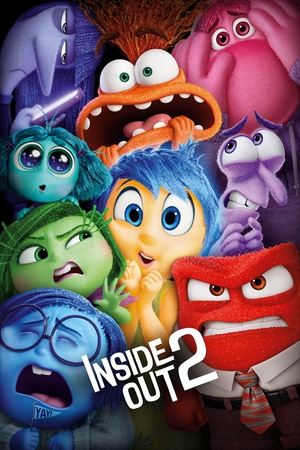
INSIDE OUT 2(2024)
Written by: Meg LeFauve & Dave Holstein (Original Story by Meg LeFauve & Kelsey Mann)
Genre: Animation
Title: Inside Out 2
Written by: Meg LeFauve & Dave Holstein (Original Story by Meg LeFauve & Kelsey Mann)
Draft date: Not specified
LOGLINE
A thirteen-year-old hockey player's emotions are thrown into chaos when a new set of feelings—led by Anxiety—seize control of her mind during a high-stakes skills camp, forcing the original emotions on a desperate journey through the recesses of her psyche to restore her authentic sense of self before she loses who she is.
| Very Poor | Poor | Fair | Good | Excellent | |
|---|---|---|---|---|---|
| PREMISE | ✓ | ||||
| STRUCTURE | ✓ | ||||
| CHARACTER | ✓ | ||||
| CONFLICT | ✓ | ||||
| DIALOGUE | ✓ | ||||
| PACING | ✓ | ||||
| TONE | ✓ | ||||
| ORIGINALITY | ✓ | ||||
| LOGIC | ✓ | ||||
| CRAFT | ✓ |
| Strong Pass | Pass | Consider | Recommend | Strong Recommend | |
|---|---|---|---|---|---|
| Overall | ✓ |
Genre: Comedy, Drama
Sub-genre: Coming-of-Age Drama, Animated Family, Buddy Comedy
Keywords: Female Protagonist, Ensemble Cast, Sequel, Dual World, Inner Life, Identity, Friendship, Hockey, Sports, Puberty, Adolescence, Self-Discovery, Anxiety, Mental Health, Imagination, Found Family
MPA Rating: PG (mild thematic elements involving anxiety and peer pressure, no strong language or violence)
Budget Tier: Ultra High ($100M+): Pixar tentpole animation requiring extensive CGI character animation, multiple elaborate interior mind-world environments, sports sequences, and crowd scenes.
Pages: 161
Time Period: Present over approximately 3 days (with brief prologue/epilogue spanning weeks)
Locations: ~40% inside Riley's mind (Headquarters, Belief System, Vault, Imagination Land, Stream of Consciousness, Back of the Mind, Fort Pillowton), ~30% at a hockey camp facility (rink, locker room, dorms, coach's office, campus pathways), ~15% in Riley's family home and car, ~15% miscellaneous (school, orthodontist, cafeteria). Mind-world locations require extensive fantastical design including subterranean root systems, floating parade balloons, a sar-chasm canyon, brainstorm weather, and pillow-fort projection rooms.
Lead: Riley Andersen, female, 13, Caucasian, tall for her age with braces, a passionate hockey player undergoing the emotional turbulence of early adolescence. Joy, female-presenting emotion, eternally optimistic but learning to accept complexity.
Comparables: Inside Out (2015) — direct predecessor exploring the same emotional-personification conceit; Toy Story 3 — sequel that deepens its world by confronting the protagonist's maturation and the fear of obsolescence; Turning Red (2022) — Pixar coming-of-age centered on a girl navigating puberty's physical and emotional upheaval; Monsters University — animated sequel built around a high-pressure competitive environment that tests identity.
SYNOPSIS
RILEY ANDERSEN (13), now a tall, braces-wearing teenager, plays in a championship hockey game with best friends BREE (13) and GRACE (13) on the Foghorns. Inside Headquarters, JOY narrates Riley's life, introducing ANGER, FEAR, DISGUST, and SADNESS at the console. Joy explains how memories feed into Riley's Belief System underground, forming beliefs that collectively create her Sense of Self—a glowing construct that affirms "I'm a good person." Riley passes the puck to Grace for the winning goal, and the team celebrates.
After the game, COACH ROBERTS, the high school varsity coach, invites Riley, Bree, and Grace to a three-day hockey skills camp. That night, Joy uses a jerry-rigged tube to send uncomfortable memories to the Back of the Mind, keeping Riley's self-image pristine. Joy and Sadness visit the Belief System together, planting the championship memory as a new belief: "I'm a winner."
An alarm blares overnight. Construction workers demolish and expand Headquarters, modifying the console for "the others." In the car to camp, Bree and Grace reveal they have been assigned to a different high school—Riley will be alone next year. Riley is devastated but holds it together.
At camp, Riley bumps into VALENTINA "VAL" ORTIZ (teenager), the varsity captain she idolizes. Four new emotions arrive: ANXIETY, an energetic orange planner; ENVY, a tiny green emotion; EMBARRASSMENT, a large shy pink figure; and ENNUI, a languid French-accented emotion who operates the console remotely via phone app. NOSTALGIA also briefly appears but is sent away as premature.
Anxiety projects worst-case scenarios for Riley's future—friendless high school lunches—and argues they must prioritize impressing Val over spending time with Bree and Grace. When Joy resists, Anxiety rips out Riley's Sense of Self and launches it to the Back of the Mind. Embarrassment bottles Joy, Anger, Fear, and Disgust in a jar, and the new emotions take over. Anxiety plants orange memories in the Belief System to grow a new Sense of Self.
The old emotions are deposited in the Vault alongside BLOOFY, a preschool-show dog character; LANCE SLASHBLADE, a melodramatic video game hero; and Riley's DEEP DARK SECRET. With help from Deep Dark Secret's brute strength and Lance's improbable chain-reaction attack on the VAULT COPS, they escape. Joy formulates a plan: follow the Stream of Consciousness to the Back of the Mind, retrieve Riley's original Sense of Self, and have Sadness climb back through a recall tube to bring them home.
Meanwhile, Anxiety drives Riley to practice obsessively, bond with Val, and distance herself from Bree and Grace. Riley acts sarcastically toward her old friends—opening a literal Sar-Chasm in the mind that destroys Joy's stream route. The Fire Hawks mention Coach Roberts keeps a red notebook with evaluations. At night, Anxiety commandeers Imagination Land's Fort Pillowton to mass-produce anxiety projections, keeping Riley awake with worst-case scenarios. Joy infiltrates the operation and rallies the mind workers into a projection revolt, shutting down Anxiety's feed so Riley can sleep.
Anxiety sends Riley to sneak into Coach's office, where she reads the notebook: "Andersen: NOT READY YET." Crushed, Riley returns to her dorm. A brainstorm erupts, flooding Headquarters with ideas. Anxiety seizes a giant idea and gives Riley a red hair streak to look like a Fire Hawk.
During the final scrimmage, Anxiety's new Sense of Self crystallizes into "I'm not good enough." Riley plays selfishly—stealing the puck from teammate DANI, scoring two goals, then shoulder-checking Grace into the boards. Sent to the penalty box, Riley has a panic attack. Anxiety spirals into an uncontrollable maelstrom around the console.
Joy and the old emotions ride an avalanche of bad memories through the canyon back to the Belief System, then take the elevator to Headquarters. Joy enters Anxiety's whirlwind and talks her down. Anxiety releases the console. Joy plugs in the original Sense of Self but realizes it is incomplete—she had been curating Riley's identity by hiding bad memories. She removes it, allowing all memories, good and bad, to feed a new, complex Sense of Self that cycles through contradictory truths: "I'm kind," "I'm selfish," "I make mistakes," "I'm strong." Joy embraces this fuller identity.
Riley calms, apologizes to Bree and Grace, and they reconcile with a fist bump and hug. She returns to the ice and plays with genuine joy. In an epilogue set at Riley's new high school, she sits at lunch with Val and the Fire Hawks. Her phone buzzes with a good-luck text from Bree and Grace—and then Coach's email arrives. Riley looks in the mirror and smiles. The emotions, old and new, work the console together, with Anxiety given a special calming chair. A mid-credits scene reveals Riley's Deep Dark Secret: she once burned a hole in a rug.
COMMENTS
PREMISE — Excellent
The premise elegantly extends the original's central metaphor—emotions as characters managing a child's inner life—by introducing puberty as a seismic disruption that makes room for new, more complex feelings. The arrival of Anxiety as a well-intentioned but destructive force creates immediate, specific conflict: she is not a villain but a necessary part of growing up, which gives the material thematic sophistication rare in family animation. Riley's hockey camp provides a clean dramatic engine—a three-day crucible with social and athletic stakes—while the parallel quest through the mindscape supplies adventure momentum. The central dramatic question, whether Riley can integrate her messy contradictions into a healthy identity, resonates beyond its target demographic. Compared to Turning Red, which externalizes puberty as physical transformation, this material internalizes it as an identity crisis, offering a complementary but distinct angle. The premise's greatest asset is its structural duality: every external choice Riley makes has a visible internal cause, ensuring that plot and theme are indivisible.
STRUCTURE — Fair
The architecture is sound and proportionally well-calibrated. The inciting incident—Bree and Grace's high school reassignment—lands around page 32 (~20%), establishing the social threat that justifies Anxiety's emergence. Anxiety's coup, removing the Sense of Self and bottling the original emotions (~58-61), functions as a clear break into the central conflict at roughly 38% of the page count, which runs slightly late but is offset by the density of world-building that precedes it. The midpoint—Joy's infiltration and revolt at Fort Pillowton (108-117)—occurs near 70%, which is proportionally late for a midpoint and closer to a traditional "all is lost" beat. Joy's emotional breakdown at the memory pile (136-137) at ~85% serves as the true low point, and Riley's panic attack and reconciliation sequence (145-152) functions as the climax at ~93%. The epilogue provides satisfying resolution. Structurally, the vault escape sequence (63-73) is entertaining but consumes ten pages that could tighten the second-act journey. The brainstorm sequence (124-128) similarly extends a chase beat that has already been established through the sar-chasm and Fort Pillowton sequences, creating slight redundancy in the adventure thread.
CHARACTER — Good
Joy's arc is the emotional spine, and it is well-constructed: she begins as a well-meaning curator who hides bad memories to protect Riley (17-18), is confronted with Anxiety's mirror-image of that same impulse (147-148), and ultimately accepts that Riley's identity must include all experiences. This is the most resonant character beat in the material. Anxiety is the standout creation—her motor-mouthed energy, her projections, and her genuine belief that she is helping Riley (46, 61, 122) give her dimensionality that elevates her beyond antagonist into co-protagonist. Riley herself, however, is structurally passive for much of the middle section; because emotions drive her decisions, she functions more as a vehicle than an agent, which is inherent to the conceit but worth noting. Among the supporting cast, Sadness's covert mission inside Headquarters (100-106, 119-122) gives her a satisfying mini-arc of bravery, and Embarrassment's silent defection (105-106, 134-135) is a well-planted payoff. Bree and Grace are functional but thinly drawn—they exist primarily as symbols of what Riley stands to lose rather than as fully independent characters.
CONFLICT — Good
The central conflict operates on three interlocking levels: externally, Riley must impress Coach Roberts to make the Fire Hawks; internally, she must reconcile her desire to belong with loyalty to her friends; and within Headquarters, Joy must reclaim Riley's identity from Anxiety. This layering ensures that nearly every scene carries tension on at least two planes. The escalation is effective—Anxiety's control tightens incrementally from choosing Val's team (57-59) to the early morning practice (76-78) to the red notebook break-in (118-123) to the selfish scrimmage play (138-144). The climactic panic attack (145-146) represents the stakes at their highest, and Anxiety's inability to stop her own spiral (146-147) gives the crisis genuine emotional danger. The one area where conflict thins is the adventure thread: the vault escape (63-73), the sar-chasm crossing (93-97), and the brainstorm flight (124-128) are entertaining set pieces, but the obstacles are largely physical and resolved through luck or gags rather than character decisions, which makes them feel less consequential than the Headquarters conflict.
DIALOGUE — Good
The dialogue is consistently differentiated and effective. Each emotion has a distinct voice that could be identified without character names: Anxiety's rapid-fire catastrophizing ("She has no one. She eats alone and only the teachers know her name," 47), Ennui's deadpan French ("Ooh la la. Joy is so old school," 45), Disgust's social acuity ("She's hiding something! But what?!" 30), and Anger's blunt physicality ("Over my dead, flaming body," 60). Joy's dialogue carries the most range—her forced optimism ("You're never lost if you're having fun!" 75) cracks convincingly into her breakdown ("OF COURSE I'M DELUSIONAL!" 102), and the tonal shift is earned by the consistency of her voice throughout. Subtext operates well in Riley's external scenes: her "Oh yeah, Get Up and Glow is so awesome" (96) is sarcasm born of shame, and the material literalizes that subtext through the sar-chasm, which is a clever formal choice. The weakest dialogue belongs to the Fire Hawks (Dani, Ally, Sofia), who speak in undifferentiated exposition about the notebook and scrimmage (86-87, 99).
PACING — Fair
The opening twenty pages move with confident efficiency, establishing the emotional world, the championship game, and the camp invitation without a wasted beat. The middle section, however, accumulates set pieces—vault escape, stream journey, sar-chasm, Fort Pillowton, brainstorm—that individually entertain but collectively extend the adventure beyond what the stakes require. The vault sequence (63-73) runs ten pages for what is essentially a jailbreak gag, and the brainstorm (124-128) adds another obstacle after the Fort Pillowton revolt has already provided Joy's major second-act victory. The result is that the emotional trajectory—Riley's deterioration and Joy's realization—feels slightly diluted by adventure padding between pages 63 and 130. Conversely, the climactic sequence from Riley's panic attack through Joy's epiphany (144-152) is paced beautifully, with the intercut between Headquarters chaos and Riley's physical distress creating urgent momentum. The epilogue (152-161) is well-proportioned and resists the temptation to over-explain the outcome.
TONE — Good
The tonal balance is the material's most reliable achievement. It moves fluidly between slapstick comedy (the vault cops' chain-reaction pratfall, 70-72), genuine emotional weight (Joy's breakdown, 102; Riley's panic attack, 145-146), and whimsical world-building (the Sar-Chasm pun, 93-94; Mt. Crushmore, 107) without any of these registers undermining the others. The one moment where tone wobbles is the Bloofy/Pouchy sequences: Bloofy's preschool-host shtick (64-69) is amusing on first encounter but his return via Pouchy in the third act (139-140) feels like a tonal regression into pure silliness at a moment when the material is building toward its most serious stakes. The "I'm not good enough" Sense of Self reveal (133) is the tonal high point—its impact depends on the preceding comedy having established normalcy, and the shift lands because the material has earned trust through consistent calibration. The sarcasm literalization (93-97) is tonally inventive, turning a character beat into a physical obstacle without breaking the world's internal logic.
ORIGINALITY — Fair
As a sequel to Inside Out, the material inherits a world and conceit rather than inventing one, which places the burden of originality on execution rather than concept. The most genuinely original contribution is the Sense of Self as a construct that can be removed, replaced, and ultimately reconceived—this gives the sequel its own philosophical center distinct from the original's "sadness is necessary" thesis. The anxiety-attack sequence, rendered as an emotional maelstrom that even Anxiety cannot control, is a set piece without a close animated precedent. Against Turning Red, which externalizes adolescent change as a giant red panda, this material's choice to keep the crisis entirely internal is a meaningfully different approach. The adventure set pieces—vault escape, brainstorm, sar-chasm—are competent but more derivative, drawing on familiar animated quest-and-chase conventions seen in everything from Wreck-It Ralph to the original Inside Out's memory dump sequence. The ending, in which Joy accepts that Riley's identity must include contradictions rather than be curated, is the freshest thematic beat and distinguishes this from simpler "accept your flaws" narratives.
LOGIC — Fair
The internal world-building is largely consistent with the rules established in the first film, and new additions—the Belief System, the Sense of Self, the console app—are introduced with enough clarity to function. One notable gap: Joy's jerry-rigged tube to the Back of the Mind (17-18) is established early as a one-way system, yet later the tube is used by Anxiety to send the Sense of Self (59), and by Embarrassment to lower it for Sadness's escape (134-135), suggesting it has capabilities beyond what Joy described. The recall tube's mechanics are also somewhat inconsistent—Sadness must be at the console to recall the others (81), but Anxiety destroys the tube from Headquarters (135), which raises the question of why the old emotions cannot simply use the elevator from the Belief System, which they do access at page 145. The brainstorm's ideas traveling through a physical tube into Headquarters (124-127) is visually logical but mechanically unclear—it is never established that ideas have a dedicated delivery system separate from the console. These are minor issues in a fantasy world, but they accumulate enough to create occasional confusion about what is and is not possible.
CRAFT — Good
The writing is efficient and cinematic, designed for animation with clear visual staging and lean action lines that communicate physical comedy through description rather than overwriting. Character introductions are handled well—Anxiety's entrance (39-40) is a masterclass in establishing personality through behavior ("I can take notes, get coffee, manage your calendar, walk your dog, carry your things, watch you sleep?"), and Ennui's phone-based console control (43) is introduced with a single visual gag that instantly communicates her character. The intercut structure between Headquarters and Riley's world is managed cleanly throughout, with IN HQ / WITH RILEY headers that maintain spatial clarity across 161 pages. The Disgust investigation sequence (30-32), intercutting between three characters' heads, demonstrates confident formatting that could easily become confusing but remains legible. Occasional stage directions are vague—"Joy looks at the new Sense of Self, and embraces it. Hugging it tightly. Protecting it" (150) tells us the emotional beat but not the visual specifics—though this is appropriate for animation where the final image will be designed in production. The page count runs long at 161, partly due to the dual-header formatting, but the adventure middle section (63-130) contains the material most susceptible to trimming.
OVERALL — Recommend
Inside Out 2 is an animated coming-of-age comedy-drama that personifies the onset of adolescent anxiety as a hostile takeover of a thirteen-year-old hockey player's emotional headquarters. Its strongest elements are the thematic premise—the idea that identity must include contradictions, not just curated highlights—and Anxiety as a character, whose well-intentioned destructiveness provides both comedy and genuine pathos. Joy's arc, from protective curator to someone who accepts messiness, completes a journey that was implicit but unfinished in the original. The dialogue is sharply individuated across a large cast, and the tonal control is reliable, moving between comedy and emotional gravity without stumbling. The material's primary weakness is structural: the adventure quest through Riley's mind accumulates more set pieces than the narrative requires, particularly the vault escape and brainstorm sequences, which entertain without advancing character understanding. The result is a slightly distended middle section that delays the most powerful material—Joy's breakdown, Riley's panic attack, and the Sense of Self revelation—longer than necessary. The supporting human characters (Bree, Grace, the Fire Hawks) remain functional rather than dimensional, which is a minor limitation given that the emotions carry the dramatic weight. At its best, particularly in the final twenty pages, the material achieves the rare feat of making an abstract psychological concept feel physically and emotionally urgent.
Get this level of coverage for your screenplay
Every coverage includes 10 category ratings, an overall recommendation, and detailed analysis — powered by the same methodology used by talent agencies and literary managers.
Movie data provided by TMDB