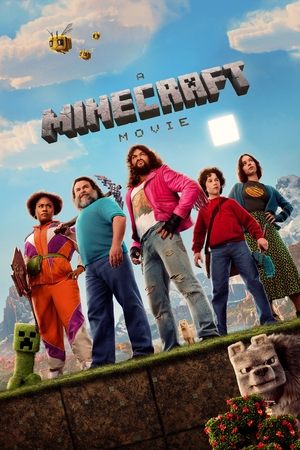
MINECRAFT(2025)
Written by: Chris Galletta (current revisions), based on the Mojang video game, with extensive prior revisions by numerous writers (see cover page)
Draft date: April 24, 2024
Genre: Action
Title: Minecraft
Written by: Chris Galletta (current revisions), based on the Mojang video game, with extensive prior revisions by numerous writers (see cover page)
Draft date: April 24, 2024
LOGLINE
A grieving teenage inventor, his overprotective older sister, a washed-up 1980s arcade champion, and a quirky mobile-zoo operator are pulled through a portal into a blocky parallel dimension, where they must retrieve a powerful artifact before an evil piglin sorceress uses it to destroy both worlds.
| Very Poor | Poor | Fair | Good | Excellent | |
|---|---|---|---|---|---|
| PREMISE | ✓ | ||||
| STRUCTURE | ✓ | ||||
| CHARACTER | ✓ | ||||
| CONFLICT | ✓ | ||||
| DIALOGUE | ✓ | ||||
| PACING | ✓ | ||||
| TONE | ✓ | ||||
| ORIGINALITY | ✓ | ||||
| LOGIC | ✓ | ||||
| CRAFT | ✓ |
| Strong Pass | Pass | Consider | Recommend | Strong Recommend | |
|---|---|---|---|---|---|
| Overall | ✓ |
Genre: Action, Comedy
Sub-genre: Action Adventure, Fantasy Comedy, Family Adventure
Keywords: Video Game Adaptation, Fish-Out-Of-Water, Sibling Bond, Portal Fantasy, Ensemble Cast, Coming-of-Age, Mentor-Protégé, Teamwork, Creativity, Small Town, Female Protagonist (secondary), Quest, Chosen One (reluctant), Monsters, Found Family
MPA Rating: PG (fantasy action violence, mild crude humor, no strong language)
Budget Tier: Ultra High ($100M+): extensive CGI/VFX for blocky Overworld environments, large-scale battle sequences, flying creatures, portal effects, creature design, multiple biomes, destruction set pieces
Pages: 97
Time Period: Present, over approximately 3-5 days of real-time action
Locations: ~25% in rural Idaho small town (video game store, high school, old house, potato chip factory, storage auction, country roads, mine entrance), ~70% in the Overworld (blocky biomes, villages, mountains, redstone mines, woodland mansion, nether portal plateau, mushroom forest), ~5% in the Nether (lava-filled throne room, dungeon). Requires extensive digital environments for the Overworld and Nether. Practical Idaho locations are modest small-town settings. Key set pieces include a flying chase sequence, a collapsing mountain, a large-scale battlefield, and a multi-floor mansion infiltration.
Lead: Henry, male, approximately 14-15, race/ethnicity unspecified, a creative, inventive teenager who draws obsessively in his sketchbook, recently lost his mother, and struggles to fit in at a new school.
Comparables: Jumanji: Welcome to the Jungle (reluctant group transported into a game world with escalating dangers and character growth), The Lego Movie (branded IP adventure blending humor with a creativity-versus-conformity theme), Pixels (nostalgic gamer culture meeting real-world stakes), Spy Kids (family-friendly action-adventure with inventive gadgets and young protagonist agency).
SYNOPSIS
A narrator introduces STEVE (adult), a timeshare salesman who yearned for adventure since childhood. Steve returns to an abandoned Idaho mine, discovers a crystal box and a cubic orb, combines them, and opens a portal to the Overworld — a blocky parallel dimension. He builds homes, tames a wolf named DENNIS, and thrives creatively until he stumbles upon a Nether portal. Dennis runs through, and Steve follows into the Nether, a hellish dimension ruled by MALGOSHA, an evil piglin sorceress. Malgosha captures Steve and the orb. Steve escapes, sends Dennis back to Earth with the orb hidden in a satchel, and remains imprisoned. Dennis hides the orb under Steve's waterbed.
Years later, GARRETT "THE GARBAGE MAN" GARRISON (40), a broke, washed-up 1980s arcade champion, runs a failing video game store in Chuglass, Idaho. Facing eviction, he buys a storage unit hoping for a rare Atari console but finds junk — and unknowingly acquires Steve's belongings, including the orb. Meanwhile, NATALIE (24), a responsible young woman raising her teenage brother HENRY (14-15) after their mother's death, moves to Chuglass for a job managing social media for a potato chip factory. Henry visits Garrett's store, and they form an unlikely connection. At school, Henry's creative jetpack project is sabotaged, destroying the town's mascot and threatening Natalie's job.
Henry, avoiding Natalie, returns to Garrett's store and combines the orb and crystal despite warnings. The artifact pulls them toward the mine. Natalie and DAWN (adult), their quirky realtor who runs a mobile petting zoo, track Henry via phone and follow. All four are sucked through the portal into the Overworld. After a terrifying first night fending off mobs, Steve arrives and saves them. He reveals the Earth Crystal — their way home — shattered when Garrett dropped the orb during the attack. Steve offers a deal: he will guide them to the Woodland Mansion where a replacement crystal exists, in exchange for the orb, which he needs as leverage to rescue Dennis from Malgosha.
In Midport Village, Steve shows them crafting tables and his lava chicken restaurant. Henry crafts a "Tot Launcher" from mundane objects, impressing Steve. Garrett secretly bargains with Steve for a diamond detour. Malgosha dispatches GENERAL CHUNGUS (a terrifying but dim piglin commander) and an army to retrieve the orb. The piglins attack Midport, splitting the group: Henry, Garrett, and Steve escape via elytra wingsuits, while Natalie and Dawn flee separately. During a thrilling aerial chase, the men evade ghasts and piglin riders.
Garrett's diamond detour through the Redstone Mines triggers booby traps and leads them into a creeper-infested cavern. The Great Hog — Malgosha's ultimate weapon — pursues them. They escape as the mountain explodes behind them. Henry confronts Garrett about his selfishness, and Garrett admits he is broke and alone. Meanwhile, Natalie and Dawn bond while fighting mobs, and Dawn tames Dennis, who leads them toward the Woodland Mansion.
At the Mansion, Steve and Garrett create a singing diversion while Henry infiltrates. Henry fights through Vindicators and Evokers, battles an Enderman whose psychic attack shows him his worst fears, and retrieves the Earth Crystal. Meanwhile, Garrett survives a brutal boxing match against a baby zombie chicken jockey with Steve's help. They escape the Mansion but are ambushed on a bridge by Malgosha, who magnetically seizes the orb. Garrett sacrifices himself to save Henry, tossing him onto a ghast before the bridge explodes.
The groups reunite at a mushroom forest safe house. Malgosha activates the orb atop the Nether portal, beginning the "Great Darkening" that blocks the sun and allows mobs and piglins to overrun the Overworld. Henry devises a battle plan. They craft iron golems, a super golem with boots of swiftness, and diamond weapons. In a massive final battle, Natalie leads the golem charge while Henry uses his tot launcher to fire an ender pearl, teleporting to the top of the portal. The Great Hog blasts him off, but Garrett — revealed alive — swoops in on a ghast and saves him. Together they destroy the orb's beam, restoring sunlight. Piglins flee. Steve confronts Malgosha, who dies trying repeatedly to stab him. Steve entrusts Dennis to Dawn, and after a bittersweet farewell, everyone steps through the portal home — Steve included.
In an epilogue, Garrett's store thrives as a community hub. Henry perfects his jetpack. Dawn opens a successful petting zoo featuring Dennis. Natalie teaches self-defense. A mid-credits scene reveals VP MARLENE and the NITWIT villager — who now speaks eloquent English — getting engaged. A post-credits scene shows Steve meeting a woman named ALEX at his old house.
COMMENTS
PREMISE — Good
The premise translates the open-ended sandbox of the Minecraft game into a quest narrative by giving the Overworld a villain, a ticking clock, and a group of mismatched real-world characters who must learn to "mine and craft" to survive. The central dramatic question — can these ordinary people retrieve the orb and stop Malgosha before she destroys the Overworld — provides clear forward momentum, while Henry's arc from self-doubting creative kid to confident builder supplies the emotional spine. The thematic throughline — that creativity is worth pursuing despite a world that punishes it — resonates across multiple characters: Henry's inventions are sabotaged, Steve's artistry was crushed, and even Malgosha's villainy stems from having her dancing dreams mocked. This gives the material more thematic cohesion than typical video-game adaptations. The ensemble structure, however, dilutes protagonist clarity: Henry is the emotional center, but Steve is the narrator and lore-holder, and Garrett commands the most screen time in the middle stretch, creating a premise that promises a coming-of-age journey but frequently delivers a buddy comedy instead.
STRUCTURE — Poor
The prologue establishing Steve's backstory and the orb's mythology runs roughly twelve pages before the title card, which is proportionally lengthy for a 97-page screenplay and delays introduction of the actual protagonist. Henry's inciting incident — combining the orb and being pulled into the portal — lands around page 28, nearly 29% of the way through, which pushes the break into the Overworld later than expected. The midpoint pivot occurs with the Midport Village piglin attack (51-55), which effectively splits the group and raises stakes. The Woodland Mansion sequence (71-78) functions as a strong third-act-style climax for the quest plot, but the actual climax — the Great Darkening battle — begins around page 85, leaving only twelve pages for the final confrontation, resolution, and epilogue, which compresses the emotional payoffs. The Garrett diamond detour (50-68) consumes nearly twenty pages for a subplot whose primary function is character revelation that could be achieved more economically. Causality generally works: the shattered crystal necessitates the mansion quest, and Henry's crafting skills set up the final battle. The Nitwit-Marlene subplot (40, 61, 70, 96) occupies four separate cutaways that interrupt momentum without connecting to the main throughline until a mid-credits gag.
CHARACTER — Fair
Henry possesses a clear backstory (grieving his mother, uprooted to a new town), a want (to belong and prove his creativity matters), and a fear (that his inventions cause harm and he is fundamentally inadequate), which the Enderman psychic attack crystallizes effectively (76-77). His arc completes when he chooses to return to the real world and "make stuff anyway" (92), which lands because the Overworld has validated what Earth rejected. Garrett is the most vividly drawn character — his bravado masking loneliness and financial desperation creates genuine pathos during his confession (70) and his bridge sacrifice (80). However, Garrett's arc overshadows Henry's in the middle stretch, and the screenplay's emotional climax (Garrett's rescue at page 89) centers on Garrett rather than Henry's agency. Natalie is underserved: her parental anxiety is established (16, 46-47) but she has no defining scene of transformation until the final battle, where her combat proficiency appears without adequate buildup beyond a brief training montage (84-85). Steve functions well as a guide and comic foil but lacks internal conflict beyond the Dennis motivation. Dawn is charming but purely functional, her animal-whisperer skill conveniently deployed exactly when needed (65).
CONFLICT — Fair
The central external conflict — retrieving the orb before Malgosha darkens the Overworld — is clearly articulated and escalates through the piglin attacks at Midport (51-55), the Great Hog pursuit in the mines (67-69), and the final battlefield (85-90). The formidability of Malgosha as an antagonist, however, is undermined by her limited screen presence and her comic treatment: she kills piglins for drawing pictures (32) and repeatedly tries to stab Steve in a slapstick sequence (91-92), which drains menace from the climax. The internal conflict between Henry's creative impulse and a world that punishes it is the material's strongest tension, but it recedes during the long middle section where Garrett's financial desperation and Steve's Dennis quest compete for emotional real estate. Scene-level conflict is abundant — nearly every sequence contains physical danger or interpersonal friction — but the Garrett-Steve rivalry (44, 48-49, 53) often substitutes bickering for escalation, producing friction without meaningful consequences until Garrett's confession (70).
DIALOGUE — Fair
The dialogue is consistently joke-forward, prioritizing punchlines over subtext, which suits the family-adventure tone but limits emotional depth. Characters are reasonably differentiated: Garrett's malapropisms and faux-Spanish ("Buenos dias, which means see you later," 57; "Vayo con dios. That means goodbye, brother," 92), Steve's surfer-dude enthusiasm ("Abso-rootin-tootley," 50), and Dawn's no-nonsense practicality ("Garbage man, you are big time idiot," 44) each have distinct rhythms. VP Marlene's oversharing creates reliable comedy (22, 40, 96). The weakness is pervasive on-the-nose exposition: Steve's explanations of game mechanics ("That is an Ender Pearl. Teleports you to wherever you throw it," 48) and Malgosha's villain monologues ("With this orb, I will pillage the overworld," 8) state information without subtext. Henry's emotional dialogue tends toward generic sincerity — "You weren't alone. I was your friend" (70) — where more specific, character-revealing language would strengthen the emotional beats.
PACING — Fair
The first 28 pages before the portal crossing contain two separate introductory sequences (Steve's prologue, then Garrett and Henry's real-world setup), and the transition between them (10) feels like a second beginning. Once inside the Overworld, pacing improves considerably: the first-night mob attack (34-38), the Midport battle (51-55), and the elytra chase (56-59) deliver well-spaced action beats with breathing room between them. The Redstone Mines detour (66-69) drags because it exists primarily to service Garrett's diamond subplot rather than advancing the main quest, and the booby-trap gags extend sequences that could be tighter. The Woodland Mansion infiltration (71-78) is the best-paced extended sequence, intercutting Henry's stealth mission with Garrett's fight club for effective tension and comic relief simultaneously. The final battle (85-90) moves briskly but compresses the emotional resolution: Garrett's return from apparent death, the orb's destruction, Malgosha's defeat, and the farewell sequence all occur within twelve pages, leaving several of these moments undercooked.
TONE — Fair
The tone aims for family-friendly action-comedy in the vein of Jumanji: Welcome to the Jungle and largely maintains that register, with physical comedy, broad character types, and stakes that threaten without genuinely disturbing. The Malgosha backstory (61-62), depicting childhood humiliation and a parent crushing creative dreams, introduces a moment of genuine poignancy that aligns well with the thematic material. However, tonal friction arises when Malgosha casually murders piglins by turning them into pork chops (32, 33) in scenes played for laughs — the violence registers as darker than the surrounding comedy supports. Garrett's bridge sacrifice (80) aims for genuine emotional weight, but his survival reveal twelve pages later (89) retroactively diminishes the moment, a tonal pattern common in this genre but still deflating. The Nitwit-Marlene romance subplot occupies a wholly different comedic register — absurdist workplace comedy — that feels imported from another project and clashes with the adventure momentum each time it appears (40, 61, 70).
ORIGINALITY — Fair
As a Minecraft adaptation, the material inherits a built-in audience and recognizable iconography but faces the challenge of imposing narrative on a game defined by its absence of narrative. The solution — a quest structure with a MacGuffin orb and a villain — is the most conventional possible framework, closely mirroring The Lego Movie's approach of giving a creativity-themed IP a chosen-one plot with a world-ending threat. The fish-out-of-water ensemble dynamic echoes Jumanji: Welcome to the Jungle substantially: mismatched real-world characters discover hidden strengths in a game-logic world, with one character serving as an experienced guide. Where the execution distinguishes itself is in the crafting-as-combat mechanic — Henry's Tot Launcher built from a tater tot and a paper clip (50), the iron golem assembly line (85), and the ender pearl loaded into a tot launcher (87) — which translates the game's creative ethos into satisfying narrative moments. The Malgosha backstory, grounding villainy in the suppression of artistic expression, adds a thematic layer that most game adaptations lack.
LOGIC — Poor
The orb's rules are inconsistently enforced. Steve's note explicitly warns "Never under any circumstances combine The Orb and Crystal" (28), yet the same note then advertises treasure, which contradicts any scenario in which Steve wrote both warnings — if he wanted the orb hidden, why include an incentive to follow it? The Earth Crystal shatters when an arrow knocks it from Garrett's hand (37), yet the replacement crystal Henry retrieves from the Woodland Mansion (75) survives far rougher treatment during the climactic battle without damage. Garrett's survival of the bridge explosion (80) is explained retroactively by "Steve's water bucket trick" (89), but the bridge is shown exploding with Garrett on it surrounded by piglins, and no bucket deployment is depicted or foreshadowed. The day-night cycle is described as occurring "every twenty minutes" (4) but only triggers at dramatically convenient moments. Dennis's journey from the Overworld through Earth and back to the Overworld is logistically unclear: he hides the orb under Steve's bed (9), but the timeline between Steve's imprisonment and the storage auction is unaddressed.
CRAFT — Fair
The writing is energetic and visually oriented, with action lines that read quickly and convey spectacle efficiently — "The skeleton CURLY-QS straight for the POTATO CHIP FACTORY" (24) communicates both trajectory and comedy in one image. Character introductions are functional but uneven: Garrett's entrance (10-11) effectively establishes his persona through environment and behavior, while Henry's introduction (16) relies almost entirely on dialogue with Natalie to convey his situation. The narrator device creates an odd structural asymmetry: Steve narrates the prologue in first person, a "Game Over World" narrator handles Garrett's backstory (10-11), and then narration largely disappears until the epilogue (94-95), making it feel like a vestigial element from an earlier draft rather than a cohesive framing choice. Stage directions occasionally include non-visual information ("Quite emotional," 16; "A total Hail Mary," 8) that describe intent rather than observable behavior. The number of credited writers is reflected in occasional tonal and stylistic inconsistencies — VP Marlene's scenes read as though written by a different hand than the Steve-Henry emotional beats. Formatting is clean, and the page count is appropriate for the genre.
OVERALL — Consider
Minecraft is a family action-comedy that transports a group of mismatched real-world characters into the blocky Overworld of the popular video game, where they must retrieve a magical artifact before an evil piglin sorceress destroys both dimensions. The material's strongest asset is its thematic commitment to creativity as both survival mechanism and source of identity — Henry's arc from rejected inventor to confident builder provides genuine emotional resonance, and the crafting-as-combat sequences translate game mechanics into satisfying cinematic moments with an inventiveness that elevates the material above rote adaptation. Garrett is the most memorable character on the page, with a vulnerability beneath his bluster that earns his sacrifice beat and his eventual growth. The primary weaknesses are structural: the twelve-page prologue and delayed inciting incident slow the opening, the diamond-mine detour inflates the second act without sufficient narrative payoff, and the compressed final twelve pages rush through emotional resolutions that deserve more space. Natalie remains underdeveloped relative to her importance, and Malgosha's comic treatment undercuts her threat level at the moments when menace matters most. The dialogue is serviceable and often funny but leans on exposition and on-the-nose emotional declarations where subtext would strengthen key scenes. The craft is professional and visually inventive, with action sequences that read dynamically on the page, though the multiple-writer history surfaces in tonal inconsistencies between the comedy subplots and the emotional throughline.
Get this level of coverage for your screenplay
Every coverage includes 10 category ratings, an overall recommendation, and detailed analysis — powered by the same methodology used by talent agencies and literary managers.
Movie data provided by TMDB