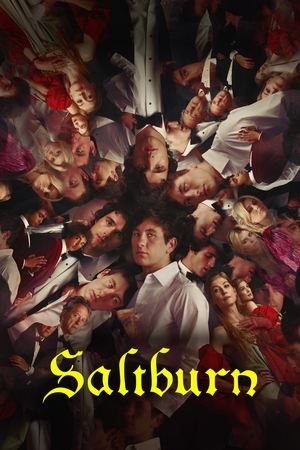
SALTBURN(2023)
Written by: Emerald Fennell
Draft date: Pink Script 20th September, 2022 (with prior drafts dated 7th July 2022 and 30th July 2022)
Genre: Drama
Title: Saltburn
Written by: Emerald Fennell
Draft date: Pink Script 20th September, 2022 (with prior drafts dated July 7, 2022 and July 30, 2022)
LOGLINE
A fiercely intelligent scholarship student at Oxford ingratiates himself into the life of a charismatic, obscenely wealthy classmate, securing an invitation to the family's sprawling country estate for the summer — where his obsession with belonging transforms into something far more calculated and lethal.
| Very Poor | Poor | Fair | Good | Excellent | |
|---|---|---|---|---|---|
| PREMISE | ✓ | ||||
| STRUCTURE | ✓ | ||||
| CHARACTER | ✓ | ||||
| CONFLICT | ✓ | ||||
| DIALOGUE | ✓ | ||||
| PACING | ✓ | ||||
| TONE | ✓ | ||||
| ORIGINALITY | ✓ | ||||
| LOGIC | ✓ | ||||
| CRAFT | ✓ |
| Strong Pass | Pass | Consider | Recommend | Strong Recommend | |
|---|---|---|---|---|---|
| Overall | ✓ |
Genre: Thriller, Drama
Sub-genre: Psychological Thriller, Dark Comedy, Class Drama
Keywords: Class Divide, Obsession, Manipulation, British Aristocracy, Oxford University, Country Estate, Unreliable Narrator, Social Climbing, Wealth, Privilege, Murder, Jealousy, Toxic Friendship, Revenge, Male Protagonist, LGBTQ+ Themes, Ensemble Cast, Period Setting (2000s)
MPA Rating: R (graphic sexual content, sustained drug use, violence, strong language throughout, disturbing images including blood and death)
Budget Tier: Medium ($10M–$40M) — English country estate requiring period-appropriate interiors and exteriors across multiple seasons, Oxford University locations, large party sequence with 100+ extras, period vehicles, moderate cast, no significant VFX but production design demands are substantial.
Pages: 124
Time Period: Primarily 2006–2007 (approximately 80%), with framing sequences and a final act set roughly 2019–2020 (approximately 20%). Spans approximately 14 years total.
Locations: Approximately 40% at Saltburn, a grand English country estate requiring a vast hall, library, maze, chapel, pond, multiple bedrooms, dining rooms, and extensive grounds. Approximately 30% at Oxford University locations including college quads, rooms, dining hall, pubs, nightclubs, and river paths. Approximately 15% in a suburban English house (Oliver's family home). Remaining 10% split between a London café, Oliver's basement flat, and interiors for the dark room framing device. The maze must be practical and large enough for multiple scenes including a death. The party sequence requires fairy-light decoration of the entire estate exterior, costumed extras, a roasting pit, and a karaoke setup.
Lead: Male, 19–mid-30s, white, British. Outwardly quiet and deferential as a young man, transforming into an impeccably dressed, aristocratic figure by his mid-thirties. Watchful, calculating, and deeply manipulative beneath a veneer of vulnerability and social awkwardness.
Comparables: The Talented Mr. Ripley (1999) — a calculating outsider who infiltrates the life of a beautiful, wealthy young man through deception and ultimately murder. Brideshead Revisited (novel/adaptations) — Oxford-era infatuation with an aristocratic family and their grand estate, class dynamics, and the seductive pull of wealth. Parasite (2019) — a family/individual who methodically displaces others to occupy a position of privilege, with dark comic tone and escalating violence. The Riot Club (2014) — Oxford privilege, class tension, and the cruelty of the British upper class.
SYNOPSIS
In the present day, OLDER OLIVER QUICK (mid-30s), impeccably dressed and aristocratic, speaks to an unseen audience about FELIX CATTON (20), insisting he was not "in love" with him. Flashback images from 2007 show Oliver's obsessive perspective on Felix — watching him punt, run through Oxford grounds, kiss girls — before revealing Oliver as the watchful figure in the shadows.
In 2006, the young OLIVER QUICK (19), a scholarship student from Prescot, Merseyside, arrives at Oxford's Webbe College. Self-conscious in his blazer and tie, he is immediately mocked by FARLEIGH START (20), a clever, pansexual American whose mother is Felix's aunt. Oliver is relegated to the outcasts' table at dinner, where he meets MICHAEL GAVEY (19), a socially abrasive math genius. Oliver spots Felix from his window and is transfixed. In tutorials with PROFESSOR WARE (50s), Farleigh publicly humiliates Oliver over his writing style.
Months later, Oliver engineers a meeting by puncturing Felix's bicycle tire and then offering his own. Felix, grateful and charming, invites Oliver into his social circle at the pub, where he discreetly covers for Oliver's inability to afford a round of drinks. Oliver abandons Michael and is absorbed into Felix's orbit — the Alpha Hotties including ANNABEL (20), INDIA (20), HARRY, and JAKE. Oliver and Felix grow close over the term, Oliver sharing fabricated stories about his parents' addiction and his father's death to deepen Felix's sympathy.
Oliver overhears Annabel calling him a charity case, and watches Felix and Annabel through his window. After exams, Felix invites Oliver to spend the summer at Saltburn, his family's grand country estate. Oliver arrives to meet the family: SIR JAMES CATTON (60s), formal and shy; ELSPETH CATTON (40s), a former model and eccentric snob; VENETIA (20s), Felix's self-conscious sister; and POOR DEAR PAMELA (30s), a society beauty overstaying her welcome. DUNCAN, the butler, observes everything.
Oliver ingratiates himself with the family. He watches Felix masturbate in their shared bathroom and then licks the bathwater from the drain. He seduces Venetia in the garden, performing oral sex on her during her period and licking the blood. Farleigh reports this to Felix, who confronts Oliver. Oliver lies, claiming Venetia initiated an unwanted kiss, and Felix believes him. Oliver then manipulates Elspeth into turning against Pamela, who is quietly expelled from the house. Pamela later dies, apparently by suicide.
Farleigh attempts to sell Palissy plates from the estate through Sotheby's. The revelation — engineered by Oliver, who sent the incriminating email from Farleigh's phone after sleeping with him — results in Farleigh's expulsion from the family.
For Oliver's birthday, Felix drives him to Prescot, where they discover Oliver's parents, PAULA (50s) and JEFF QUICK, are alive, healthy, and thoroughly middle-class — exposing every lie Oliver has told. Felix, disgusted, tells Oliver he must leave Saltburn after the birthday party. At the elaborate Midsummer Night's Dream-themed party, Oliver desperately pursues Felix, follows him into the maze where Felix is having sex with India, and confronts him. Felix tells Oliver he makes his "blood run cold."
After the confrontation, Oliver poisons the champagne bottle with drugs and hands it to Felix. Felix drinks. The next morning, Felix is found dead in the maze center, his angel wings still on. The family is shattered. At the funeral lunch, Oliver deflects suspicion onto Farleigh by mentioning cocaine use, and Sir James banishes Farleigh permanently.
Oliver remains at Saltburn through the aftermath. Venetia, increasingly hostile and suspicious, confronts him in the bath. That night, Oliver places razor blades beside the unconscious Venetia, and she is found dead in the morning. Sir James eventually offers Oliver money to leave, and Oliver departs.
Years later, Oliver reads Sir James's obituary and engineers a "chance" encounter with Elspeth at a London café. She invites him back to Saltburn. Over months, he manipulates the grieving, isolated Elspeth into rewriting her will in his favor. When she falls ill and is on a ventilator, Oliver delivers his final monologue — revealing every deception — then disconnects her breathing apparatus and watches her die. He buries her beside Felix, Venetia, and Sir James. In the final sequence, Oliver dances naked through the house he now owns, straightening the family's memorial pebbles on the music box. He is the sole master of Saltburn.
COMMENTS
PREMISE — Good
The premise — a calculating outsider who deceives his way into a wealthy family's inner circle and systematically destroys them to claim their estate — occupies well-charted territory alongside The Talented Mr. Ripley and Parasite, but distinguishes itself by centering the action within the specific rituals and codes of the English aristocracy. The pairing of Oliver's working-class intelligence with the Cattons' oblivious entitlement creates inherent tension at every interaction, from breakfast etiquette to karaoke song selection. The central dramatic question — how far will Oliver go, and will anyone see through him? — sustains engagement across 124 pages. The thematic proposition that extreme privilege creates a vulnerability to predation is compelling and darkly comic. The decision to frame the narrative as Oliver's retrospective confession adds a layer of unreliable narration that recontextualizes earlier scenes effectively. Where the premise is most potent is in its understanding that the Cattons' casual cruelty (gossiping about Oliver's poverty, ejecting Pamela, ignoring Farleigh's legitimate grievances) makes them complicit in their own destruction without fully excusing Oliver's sociopathy.
STRUCTURE — Fair
The architecture is clean and proportionally sound: the inciting incident — Oliver engineering his first real encounter with Felix via the punctured bicycle tire — lands around page 14 (11%), and the commitment to the central arena occurs when Oliver arrives at Saltburn around page 36 (29%), slightly late but justified by the Oxford setup's investment in character dynamics. The midpoint arrives with Felix's discovery of Oliver's lies at Oliver's family home (pages 84–89, approximately 68%), which functions as the major reversal but falls later than ideal, compressing the consequences into a rushed back half. Felix's death — the climactic act of the 2007 timeline — occurs off-screen between pages 97 and 99, which is a bold structural choice that trades visceral impact for the family's devastating morning-after sequence. The final twenty pages shift into a present-day timeline that covers years in montage, and the reveal of Oliver's full machinations (119–122) arrives as a series of brief flashback corrections rather than as dramatically discovered information. This retrospective revelation is structurally functional but creates a telling-not-showing problem: the audience is informed of Oliver's agency rather than experiencing it unfold. The Farleigh subplot and the Venetia subplot both resolve through expulsion or death in quick succession (pages 79–82 and 112), giving the second half a pattern of eliminate-and-move-on that reduces dramatic surprise after the first instance.
CHARACTER — Good
Oliver is a meticulously constructed protagonist whose arc inverts the typical trajectory: he begins as an apparent underdog and is revealed to be the predator, with the final montage reframing his every sympathetic moment as calculated manipulation. His want (to possess Felix's world) and his need (to control and consume) are effectively collapsed into one drive, which makes him fascinating but limits his internal conflict — there is no genuine moment of hesitation or moral cost to his actions. Felix is vividly drawn as the golden boy whose kindness is real but shallow, incapable of surviving contact with genuine darkness (31–35), and his confrontation in the maze (95–97) is his strongest moment, where his disgust registers as the one honest response Oliver cannot manipulate. Elspeth is the most richly realized supporting character, her compulsive chatter about cake during the post-death lunch (102–104) revealing her survival mechanism with devastating precision. Farleigh functions as both rival and mirror to Oliver — another dependent orbiting the Cattons' wealth — and his speech at the party about Oliver's expendability (93–94) is the ensemble's sharpest piece of characterization. Venetia, however, remains underdeveloped beyond her role as a pawn between Oliver and Felix. Her bulimia, her provocations, and her suspicions of Oliver (110–111) suggest a character with the insight to be a true antagonist, but she is dispatched before that potential is realized.
CONFLICT — Fair
The central external conflict — Oliver's campaign to infiltrate and ultimately possess the Catton family and their estate — is well-constructed and escalates through a series of obstacles: social gatekeeping at Oxford, Farleigh's antagonism, Felix's discovery of Oliver's lies (86–90), and Sir James's attempt to buy Oliver off (113–114). The internal conflict, however, is largely absent. Oliver's voiceover claims ambivalence ("I loved him... I hated him"), but his actions from the bicycle sabotage onward (119) are uniformly strategic, leaving no scene in which his emotions genuinely interfere with his plans. The most potent conflict in the material is actually Farleigh's: his argument with Felix about the family's financial control (69–70) and his desperate plea when caught with the plates (79) dramatize the real cost of dependency on the wealthy in ways Oliver's storyline, because of its sociopathic clarity, cannot. Scene-level conflict is strong throughout the Oxford and early Saltburn sections — the karaoke humiliation (75–76), the dinner with Lady Daphne (72–73), the breakfast egg embarrassment (54) — but diminishes in the final act, where Oliver encounters no meaningful resistance to his endgame.
DIALOGUE — Good
The dialogue is the material's most consistent strength, with each character possessing a voice identifiable without attribution. Elspeth's breathless, self-regarding monologues — pivoting from sympathy to cruelty within a single speech ("She's had an awful time... But she is rather dull actually," 45) — are pitch-perfect. Farleigh's lines carry a specific cadence of camp cruelty ("What friends?" 65; "A real human boy?" 33). Felix's speech patterns — generous, breezy, slightly dim — are established early ("Fuck 'em," 24) and remain consistent through his final confrontation ("You make my fucking blood run cold," 97). Michael Gavey's insistent "FUCKING ASK ME A SUM THEN" (8) establishes him instantly and efficiently. The dialogue also carries subtext well: the post-funeral lunch conversation about chocolate cake (102–103) is excruciating precisely because every participant knows it means nothing and cannot stop. Oliver's dialogue is the trickiest element — necessarily bland in his chameleon phase, which means his present-day monologue must carry his personality retroactively. The final monologue (118–122) is functional exposition but lacks the wit of the ensemble scenes, becoming a lecture rather than a dramatic exchange.
PACING — Poor
The first sixty pages move briskly, with the Oxford section efficiently establishing Oliver's outsider status, his seduction of Felix, and his arrival at Saltburn through well-varied scenes that alternate between intimate two-handers and group dynamics. The Saltburn summer montages (55–57) condense time effectively. The pacing falters in the stretch between Oliver's birthday trip home (83–89) and Felix's death (99): this sixteen-page sequence must accommodate the drive to Prescot, the family revelation, Felix's rejection, the entire party, the maze confrontation, and Felix's death, creating a compressed, rushed feeling at precisely the moment the narrative needs to breathe. Conversely, the post-Felix-death section (100–114) spends considerable time on aftermath — the funeral lunch, Venetia's decline, Sir James's buyout — without escalating tension, since Oliver faces no credible threat of exposure. The final present-day sequence (115–124) accelerates through years of elapsed time in montage, making Elspeth's demise feel mechanically efficient rather than dramatically earned. The reveal montage of Oliver's true actions (119–122) plays as a checklist rather than a dramatic crescendo.
TONE — Fair
The tonal control through the first two-thirds is precise and distinctive, balancing dark comedy with genuine menace. The post-funeral lunch scene (101–105) is the tonal high point — the absurdity of discussing cake while a coroner wheels a body past the window achieves a register that is simultaneously funny, horrifying, and deeply sad. The scene where Elspeth discusses Pamela's departure with cheerful ruthlessness (60) and the breakfast egg sequence (54) sustain this comic-gothic register effectively. The tone destabilizes in the final act. Oliver's climactic monologue over Elspeth's unconscious body (118–122) shifts into a mode of villainous exposition that feels imported from a different, more conventional thriller. The final sequence — Oliver dancing naked through the house — aims for triumphant transgression but risks tipping into camp without the counterweight of any surviving character's perspective. The material is strongest when Oliver's darkness is refracted through the family's obliviousness (the "Rent" karaoke, 75–76). When it becomes a solo performance, the tonal complexity flattens.
ORIGINALITY — Fair
The Ripley comparison is inescapable — a calculating, class-conscious young man who infiltrates a wealthy circle through deception, eliminates his rival, and assumes elements of his identity — and the material does not fully escape its shadow. The execution, however, brings genuine distinctiveness in its specificity about English class codes: the nuances of breakfast protocol, the rental tuxedo's sleeves, the Palissy plates as both cultural currency and theft target. The Brideshead Revisited influence is openly worn (the golden summer at a country estate, the seductive family, the outsider narrator) but inverted by making the outsider the predator rather than the seduced. The bathtub drain scene and the period-blood sequence push into body-horror territory that has no direct precedent in the social-climbing thriller genre, and the karaoke-as-weapon scene is a genuinely original set piece. The structural choice to withhold Oliver's agency until a final-act reveal recontextualizes familiar beats but also means that, on first viewing, the middle sections play as conventional fish-out-of-water drama. The ending — Oliver as naked king of his stolen castle — is a strong image but echoes Parasite's basement revelation in its thematic conclusion that the system itself enabled the intruder.
LOGIC — Poor
The internal logic holds under scrutiny for most of the narrative but strains at several critical junctures. Oliver's plan to poison Felix with a vial of drugs administered via champagne in the maze (121–122) depends on Felix drinking from a bottle that a visibly hostile Oliver hands him moments after vomiting — a sequence that requires Felix to be both disgusted by Oliver and casually willing to share his contaminated bottle (97). The Farleigh frame-up depends on Oliver accessing Farleigh's phone after a sexual encounter (119) and sending an email to Sotheby's that Farleigh never notices or denies having sent — yet Farleigh is presented as sharp enough to recognize Oliver's manipulations in every other context. Venetia's death is staged by placing razor blades beside her in the bath (122), but the material does not address whether a toxicology report or investigation would flag the absence of hesitation marks or other forensic inconsistencies — the Cattons' wealth and desire for privacy is implied as sufficient cover, but this is never dramatized. The present-day timeline's logic is cleaner: Oliver's "chance" encounter with Elspeth (115–116) is revealed as staged, and her vulnerability to manipulation is well-established.
CRAFT — Good
The writing demonstrates strong visual instincts and economy of description. Character introductions are vivid and functional — Elspeth is captured in a single clause ("a former model and socialite whose eccentricities and bohemian clothes only marginally obscure her snobbishness," 40), and Duncan is "tall, grey, and an all-seeing snob" (36). The POV device in the opening montage — showing scenes first from Oliver's perspective, then reversing to reveal him as the watcher (3) — is an elegant piece of craft that establishes the unreliable frame. Action lines are lean throughout, with effective use of sensory detail: "the final slurps of water gurgles down the plughole" (58) before the bathwater scene. Felix's tour of Saltburn (38) efficiently conveys scale while characterizing his dismissiveness. The formatting is clean with minor inconsistencies — Venetia's name alternates between "Venetia" and "Venitia" throughout (e.g., pages 42, 54, 55, 62), which is a proofreading issue that would cause confusion in production. The parenthetical note explaining Oliver's changed voice (6) breaks the fourth wall in a way that should be dramatized rather than annotated. The final montage of reveals (119–122) relies heavily on voiceover and brief flashback inserts, which reads as efficient on the page but represents a shift from the dramatized scenes that precede it.
OVERALL — Consider
Saltburn is a class-conscious psychological thriller about a calculating scholarship student who infiltrates an aristocratic Oxford family and systematically eliminates them to claim their estate. The material's greatest strengths are its dialogue — consistently sharp, differentiated, and layered with subtext — and its ensemble characterization, particularly Elspeth and Farleigh, whose scenes crackle with comic cruelty and genuine pathos. The tonal achievement of the post-funeral lunch sequence exemplifies the material at its best: social comedy and horror occupying the same breath. The primary weakness is structural: the decision to withhold Oliver's true agency until a retrospective montage means the protagonist lacks internal conflict for most of the narrative, and the final reveal plays as exposition rather than drama. The pacing compresses the most consequential events (Felix's death, Venetia's death) while expanding aftermath scenes that, without a credible threat to Oliver, plateau in tension. Oliver himself is a fascinating construction — the material earns its final reversal — but his sociopathy is so complete that the emotional stakes narrow rather than deepen as the body count rises. The craft is polished, the world is richly realized, and the premise delivers on its dark promise, but the gap between the vibrant ensemble drama of the first two-thirds and the mechanical endgame of the final third represents the material's most significant structural challenge.
Get this level of coverage for your screenplay
Every coverage includes 10 category ratings, an overall recommendation, and detailed analysis — powered by the same methodology used by talent agencies and literary managers.
Movie data provided by TMDB