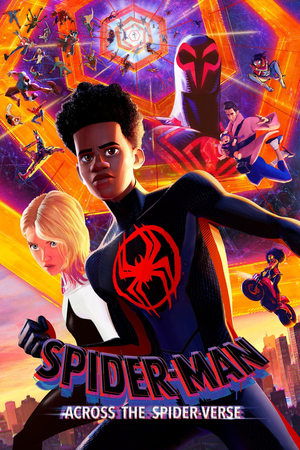
SPIDER-MAN: ACROSS THE SPIDER-VERSE(2023)
Written by: Phil Lord & Christopher Miller & Dave Callaham
Genre: Animation
Title: Whac-A-Mole (aka Spider-Man: Across the Spider-Verse)
Written by: Phil Lord & Christopher Miller & Dave Callaham
Draft date: Not specified
LOGLINE
A teenage Spider-Man in Brooklyn, struggling to balance his double life with his parents' expectations, discovers a vast interdimensional society of spider-heroes — only to learn that the tragic events binding their lives together may demand his own father's death, forcing him to defy the multiverse itself to save his family.
| Very Poor | Poor | Fair | Good | Excellent | |
|---|---|---|---|---|---|
| PREMISE | ✓ | ||||
| STRUCTURE | ✓ | ||||
| CHARACTER | ✓ | ||||
| CONFLICT | ✓ | ||||
| DIALOGUE | ✓ | ||||
| PACING | ✓ | ||||
| TONE | ✓ | ||||
| ORIGINALITY | ✓ | ||||
| LOGIC | ✓ | ||||
| CRAFT | ✓ |
| Strong Pass | Pass | Consider | Recommend | Strong Recommend | |
|---|---|---|---|---|---|
| Overall | ✓ |
Genre: Action, Sci-Fi
Sub-genre: Action Adventure, Coming-of-Age Drama, Animated Superhero
Keywords: Superhero, Multiverse, Father-Son Relationship, Secret Identity, Ensemble Cast, Female Protagonist (dual), Teen Protagonist, Mentor-Protégé, Found Family, Interdimensional Travel, Sacrifice, Destiny vs. Free Will, Based on Comic Book, Sequel, Animated, Latino Protagonist, Diverse Cast
MPA Rating: PG-13 (fantasy action violence, mild language including one instance of "fuck," thematic intensity involving parental death)
Budget Tier: Ultra High ($100M+) — extensive CGI/animation across multiple distinct visual dimensions, enormous cast, elaborate action sequences, numerous fantastical locations
Pages: 158
Time Period: Present over approximately 2-3 days
Locations: Approximately 30% Brooklyn/New York City (Earth-1610), 15% Chelsea/New York (Earth-65, Gwen's dimension), 15% Mumbattan (Earth-50101, Indian-inspired metropolis built into a crevasse), 20% Nueva York (Earth-928, futuristic Spider-Society HQ), 5% Queens (Earth-616, Peter B. Parker's home), 10% Earth-42 (dark alternate Brooklyn), 5% miscellaneous dimensions (Lego Manhattan, 1960s Ditko dimension, live-action bodega, liminal space). Each dimension requires a distinct visual identity. Major set pieces include the Guggenheim Museum interior, a collapsing cantilevered Alchemax building, a vertical highway/space train, and numerous portal transitions.
Lead: Miles Morales — Male, 15, Afro-Latino (Black and Puerto Rican), lanky teenager with a new growth spurt, earnest, funny, emotionally intelligent but stretched thin between his superhero duties and family obligations. Secondary lead: Gwen Stacy — Female, approximately 16, White, pink-streaked hair, guarded and lonely beneath a confident exterior.
Comparables: Spider-Man: Into the Spider-Verse (2018) — direct predecessor in tone, visual ambition, and character relationships; The Empire Strikes Back (1980) — second chapter that darkens the stakes, separates the heroes, and ends on a cliffhanger with the protagonist's identity and allegiance in crisis; X-Men: Days of Future Past (2014) — multiverse/time-travel stakes where saving one person threatens the larger fabric; Everything Everywhere All at Once (2022) — multiversal scope grounded in parent-child emotional dynamics.
SYNOPSIS
GWEN STACY (16), a drummer in a high school band and the secret Spider-Woman of Earth-65, narrates her isolation. In flashback, her best friend PETER PARKER (16) transformed himself into the Lizard and died during their fight, leaving Gwen's father, police Captain GEORGE STACY (Adult), believing Spider-Woman is a murderer. Gwen's bandmates — EM JAY, GLORY, and BETTY (all teenagers) — confront her emotional withdrawal, but she storms out rather than open up.
A distress call sends George to the Guggenheim Museum, where a Renaissance-era ADRIANO TUMINO (Adult), a Vulture variant from another dimension, is wreaking havoc. Gwen arrives as Spider-Woman and engages Adriano until MIGUEL O'HARA (Adult), Spider-Man 2099, portals in with his AI assistant LYLA (virtual) and pregnant colleague JESS DREW (Adult), Spider-Woman of Earth-332. The trio defeats the Vulture, but George corners Gwen at gunpoint. Desperate, Gwen unmasks. George, unable to reconcile his daughter with the vigilante he blames for Peter's death, begins reading her rights. Miguel intervenes, trapping George, and offers Gwen a dimensional watch — an escape. She takes one last look at her father and vanishes.
In Brooklyn, Earth-1610, MILES MORALES (15) battles THE SPOT (Adult), a goofy villain covered in interdimensional holes, at a bodega run by LENNY (Adult). Miles juggles the fight with texts from his father JEFF MORALES (Adult) and mother RIO MORALES (Adult), who wait with college counselor MS. WEBER (Adult) at Visions Academy. Miles' roommate GANKE (15) refuses to be his sidekick. At the counselor meeting, Miles advocates for Princeton's quantum physics program while his parents resist the idea of him leaving Brooklyn.
Miles' spider-sense pulls him back to the Spot, and their fight crashes through Jeff's police car and eventually to the old Alchemax collider site. Spot reveals he was DR. JOHNATHON OHNN, the scientist whose experiment brought the radioactive spider from Earth-42 that bit Miles — making them, in Spot's view, each other's creator. Spot accidentally kicks himself into his own interdimensional holes and disappears into liminal space, where he discovers his portals can reach any dimension.
Jeff confides in Spider-Man (not knowing it is Miles) about his frustrations with his son. Meanwhile, Spot visits multiple dimensions before returning to Earth-1610 drained of spots but newly ambitious. On Earth-13122, LEGO PETER PARKER (Adult) reports an anomaly to Miguel's network.
At Jeff's promotion party, Miles arrives late with two ruined cakes. Rio and Jeff ground him for two months after a heated argument. Alone in his childhood bedroom, Miles is stunned when Gwen drops through an interdimensional portal. They swing through Brooklyn together, and Gwen describes the Spider-Society and her new colleagues, including HOBIE BROWN (Adult), the anarchist Spider-Punk. Atop a clock tower, Gwen and Miles share an intimate moment — she tells him in every universe Gwen Stacy falls for Spider-Man, and it never ends well. Miles' hand reaches for hers; she leans against his shoulder.
Back on the roof, Rio embarrasses Miles in front of Gwen before pulling him aside for a tender conversation, making him promise to take care of the boy she raised. Gwen's watch alarm goes off — she has been secretly monitoring Spot via a spider-cam. She says goodbye to Miles and portals away, but Miles overhears her holographic conversation with Jess and learns he is explicitly excluded from their team. He also watches a holographic replay of Spot building a micro-collider and vanishing into its beam. When Gwen portals to Earth-50101, Miles leaps in after her.
In Mumbattan, Miles finds Gwen pursuing a newly powered-up Spot alongside local hero PAVITR PRABHAKAR (16), Spider-Man India. Miles' unexpected appearance distracts Gwen and gives Spot an advantage. Hobie arrives, shattering a force field with his guitar. Despite the four spiders' combined efforts, Spot reaches Mumbattan's Alchemax collider and absorbs its dark energy, triggering a terrifying vision in Miles' spider-sense: Spot destroying Brooklyn, and Jeff dying while saving a child in a red shirt. Half the Alchemax building collapses toward the city. Miles takes charge, directing the team. He saves INSPECTOR SINGH (Adult), Pavitr's girlfriend GAYATRI's (16) father, from falling rubble — unknowingly disrupting what the Spider-Society calls a "canon event."
Jess arrives with a Spider-SWAT team and orders everyone to Miguel's headquarters in Nueva York, Earth-928. At Spider-Society HQ, Miles meets hundreds of spider-people including MARGO KESS (teenager), Spider-Byte, and sees the Go Home Machine that sends anomalies to their home dimensions. He reunites with PETER B. PARKER (Adult), now a father to baby MAYDAY PARKER (infant). Miguel reveals the multiverse's structure: canon events — tragedies like Uncle Ben's death or a police captain dying — bind every spider's story together. When canon events are disrupted, dimensions collapse, as Miguel learned when he replaced a dead alternate version of himself and watched that entire world disintegrate, losing his adopted daughter GABRI (Child). Miles' disruption of Singh's death is already destabilizing Mumbattan.
Miguel reveals that Jeff's death is a predicted canon event, set to occur in two days at his captain's swearing-in ceremony. Miles refuses to accept this. Miguel further reveals that the spider that bit Miles was from Earth-42 and was never meant to bite him — Miles is "the original anomaly," and his existence caused his dimension's Peter Parker to die. Miguel imprisons Miles in a containment field. Using the palm technique Hobie hinted at, Miles venom-blasts free and flees through the entire headquarters in an extended chase involving scores of spider-people. On a vertical highway, Miguel brutally tells Miles he does not belong. Miles absorbs energy from Miguel's suit and blasts him away, then uses the Go Home Machine to escape — but the machine reads his DNA as Earth-42, sending him to the wrong dimension.
Gwen is forcibly sent home to Earth-65 by the Go Home Machine. In her old room, she confronts George, who reveals he has quit the police force — breaking the canon event pattern. He tells her she is the best thing he has ever done. She finds a package from Hobie containing a homemade interdimensional watch. Meanwhile, Miles lands in Earth-42's dark, Spider-Man-less Brooklyn, where Jeff is dead and Rio struggles financially. AARON DAVIS (Adult) is alive here but captures Miles. The PROWLER unmasks — it is Earth-42's MILES G. MORALES, hardened and braided, who has become the dimension's Prowler.
Back on Earth-1610, Spot returns to the collider wreckage, pulsing with power. Gwen visits Jeff and Rio, who are worried about their missing son, and promises to find Miles. She then recruits Peter B. (with baby Mayday), Pavitr, Hobie, Margo, PENI, HAM, and NOIR into a new team. On Earth-42, Miles sparks electricity through a hole in his rubber glove restraint. Gwen looks directly at the audience and asks, "You want in?" — and leaps.
COMMENTS
PREMISE — Excellent
The premise extends the foundation of its predecessor by inverting the original's central question — from "can anyone wear the mask?" to "what if wearing the mask was a cosmic mistake?" — and grafting onto it a conflict between individual agency and systemic determinism that resonates well beyond superhero fiction. Miles Morales is uniquely suited to this dilemma: a biracial teenager from Brooklyn who has already proven himself but now faces an authority structure (Miguel's Spider-Society) that tells him his very existence is an error, and that saving his father would destroy reality. The dramatic engine — a ticking clock toward Jeff's death, an antagonist in Spot who mirrors Miles' origin, and a protagonist forbidden from acting — is potent and layered. Gwen's parallel thread, in which the person hunting her is the person who raised her, enriches the thematic cohesion around parents and children who cannot see each other fully. The central tension between fate and choice positions the material in the territory of Greek tragedy filtered through a teenager's defiance, giving it genuine philosophical weight alongside its spectacle.
STRUCTURE — Fair
The narrative divides cleanly into two distinct halves — Gwen's prologue and the Brooklyn-based setup occupy roughly the first sixty pages, while the Mumbattan mission, Spider-Society revelation, and chase occupy the second. The inciting incident for Gwen (unmasking before George, 19-21) arrives early and propels her into Miles' orbit, while Miles' inciting incident (Gwen's arrival, 62) lands at approximately 40% of the page count, which is late for a dual-protagonist structure; the intervening material — Spot's bodega fight, the counselor meeting, Jeff's party — is entertaining but delays Miles' entry into the central conflict. The midpoint revelation of the canon events and Miguel's ultimatum (115-120) is devastating and well-positioned, arriving just past the halfway mark and reframing everything that preceded it. The extended chase sequence from HQ (122-135) functions as a sustained climactic action beat that culminates in Miles' escape — but because the Go Home Machine twist sends him to the wrong dimension (134-135), the resolution is deferred entirely. The screenplay is structured as the first half of a larger narrative, ending on Earth-42 with Miles captive and Gwen assembling a rescue team (155-158). This cliffhanger is emotionally effective but means no major conflict is resolved within this draft, which places enormous structural weight on the sequel to deliver payoffs.
CHARACTER — Good
Miles' arc across this draft moves from confident-but-overstretched hero to someone whose identity is shattered by Miguel's revelation that he is "the original anomaly" (131-132), and his defiant declaration — "I'm gonna do my own thing" (133) — represents genuine growth even as the arc remains incomplete. His emotional intelligence is demonstrated through the scene with Jeff at the construction overlook (47-49), where he counsels his own father without Jeff knowing, and his vulnerability is palpable when he tries to reveal his identity to the wrong Rio (147-148). Gwen is the stronger emotional presence in the first act, carrying the weight of her backstory with Peter and George through the Guggenheim sequence (7-22), and her reconciliation with George (140-143) is arguably the most complete character arc in the draft. Miguel functions as a compelling antagonist-figure whose own grief (the loss of Gabri, 118) justifies his rigidity without excusing it. Spot's transformation from comic relief to genuine threat is well-calibrated — his origin speech at the collider site (43-45) earns sympathy, and his dark-matter apotheosis (94-95) earns dread. The supporting cast is vast, and while Hobie, Pavitr, and Peter B. each have distinct personalities, the sheer number of spider-people introduced in HQ (101-107) risks diluting focus precisely when the emotional stakes demand concentration.
CONFLICT — Good
The central conflict operates on three simultaneous levels: Miles versus fate (can he save Jeff without destroying reality), Miles versus Miguel (the authority figure who insists he cannot), and Miles versus his own fear that Miguel is right. This layering is the material's greatest engine, established with precision when Miguel's presentation of the canon events (115-118) transforms a superhero premise into a moral dilemma with no clean answer. The scene-level conflict is equally strong — every conversation between Miles and his parents contains the dramatic irony of his secret identity, most pointedly in the counselor's office (33-37) and at the party (57-61), where the pressure of what he cannot say drives escalation naturally. Spot as external antagonist is well-handled through escalation: a joke in the bodega (23-27), a credible threat in Mumbattan (82-89), and a harbinger of apocalypse after the collider (94-95). The internal conflict — Miles questioning whether he belongs as Spider-Man at all — reaches its peak during the train confrontation with Miguel (130-133), but because the draft ends before Miles can act on his resolve, the payoff is entirely deferred. The Gwen-George conflict, by contrast, resolves beautifully (140-143), providing the emotional catharsis the Miles thread withholds.
DIALOGUE — Good
The dialogue is consistently individuated and frequently brilliant in its ability to convey character through cadence rather than exposition. Miles' code-switching between casual teen vernacular and his deep "Brooklyn accent" Spider-Man voice (40, 46) is a running gag that also communicates his fractured identity. Hobie's impenetrable British slang — "I ain't got a Scooby Doo mate" (108) — contrasts sharply with Pavitr's earnest indignation about "chai tea" (86), and both are distinct from Miguel's clipped, weary authority. The dialogue carries enormous expositional weight — Miguel's canon event lecture (115-118) delivers dense multiverse mechanics — but it works because it is intercut with character reactions and because Miles keeps interrupting with emotional questions rather than letting it become a monologue. Rio's rooftop speech to Miles (74-75) is the dialogue highlight of the draft, achieving genuine tenderness without sentimentality: "Wherever you go from here, you have to promise to take care of that little boy for me." The weakest dialogue belongs to the parade of cameo spider-people in HQ (101-107), where the quips begin to blur together and the law of diminishing returns applies.
PACING — Fair
The first forty pages move at a deliberate pace, establishing two worlds and two protagonists before their paths converge. The Guggenheim sequence (10-22) is tightly paced, but the stretch between Miles' fight with Spot and Gwen's arrival (25-62) relies heavily on character vignettes — the counselor meeting, the notebook montage, Jeff's speech, the party argument — that are individually strong but collectively slow the momentum. Once Gwen arrives in Miles' room (62), the pace accelerates sharply and rarely relents through Mumbattan, Spider-Society HQ, and the chase. The HQ tour (101-110) is the one section in this back half where the pace sags, as the roster of cameos and visual gags, however charming, delays the confrontation with Miguel that the narrative is building toward. The chase sequence (122-135) sustains tension across thirteen pages through constant escalation and venue changes, though it risks exhaustion by the time Miles reaches the Go Home Machine. The Earth-42 coda (150-157) wisely downshifts into quiet dread, but the cliffhanger ending means the pacing has no true resolution beat — the audience is left in sustained tension rather than release.
TONE — Good
The tonal register shifts fluidly between comedy, adolescent romance, family drama, and existential superhero stakes, and the transitions almost always work because the comedy is character-driven rather than imposed. The most delicate tonal moment is the clock tower scene between Miles and Gwen (67-69), which balances romantic yearning with the melancholy of Gwen's knowledge that "it doesn't end well" — a line that operates as both character confession and meta-commentary. The shift into darkness during Miguel's canon event presentation (115-120) is earned by the preceding lightness, and the material resists the temptation to undercut the emotional devastation with jokes. The Earth-42 sequence (150-157) achieves genuine menace through its stripped-down atmosphere. The one tonal wobble occurs during the HQ tour, where gags like Spider-Cat's hairball (123), the Spider-Therapist (124), and the horse-mounted Web-Slinger (124) pile up in a way that briefly makes the world feel like a theme park rather than a functioning organization, slightly undermining the gravity of what follows.
ORIGINALITY — Good
While the multiverse-hopping superhero premise is well-established — Everything Everywhere All at Once explored similar existential-through-absurdist territory, and Spider-Man: Into the Spider-Verse built the specific foundation this material extends — the execution here finds genuinely original ground in its central philosophical conflict. The idea that heroism requires tragedy, and that a hero who prevents tragedy may be more destructive than the villain, is not new in abstract (see Watchmen), but filtering it through a fifteen-year-old being told by an entire society that his father must die, and that his own existence is a mistake, gives it a specificity and emotional directness that distinguishes it from both predecessors and contemporaries. The Spot's arc from laughable to terrifying within a single draft is an uncommonly effective villain escalation. The most original structural choice is ending not with triumph but with the protagonist trapped in the wrong universe, his identity weaponized against him by a machine that reads his DNA as belonging somewhere he has never been — a literalization of the immigrant experience of being told you do not belong that is both thematically resonant and narratively surprising.
LOGIC — Good
The multiverse mechanics are internally consistent within the rules established: the watch prevents glitching (102-103), the Go Home Machine reads dimensional DNA (134), and canon events function as structural necessities whose disruption causes dimensional collapse (117-118). The one significant logic gap is the Go Home Machine reading Miles as Earth-42 — this is clearly intended as a dramatic revelation, but the mechanism assumes the machine scans the spider-bite's origin rather than Miles' actual biology, which is never explicitly established before it happens (134). Miguel's claim that Miles' existence caused Peter Parker's death and prevented the collider from being stopped (132) is presented as fact but functions more as Miguel's interpretation, since the audience saw Miles destroy the collider in the previous film. The screenplay is self-aware about this ambiguity — Gwen asks "Do you know for certain what happens if he breaks the Canon?" (137) — but it leaves open whether Miguel is correct or ideologically rigid, which is productive ambiguity rather than a plot hole. Spot's power escalation from unable-to-rob-a-bodega (23-25) to dimension-hopping supervillain (82-95) is rapid but supported by the micro-collider sequence (77-78).
CRAFT — Good
The writing operates at a high level of controlled energy, deploying a maximalist approach — editorial footnotes, comic-book drop panels, meta-commentary, dimension-specific visual languages — that could easily overwhelm but instead creates a distinctive and propulsive reading experience. Character introductions are sharp and efficient: Spot is introduced as "a goofy-looking villain-of-the-week covered in HOLES" who "casually passes by LENNY" (23), immediately establishing both his threat level and comic register. Action description balances clarity with personality — "Gwen swings onto his back like a cowboy slowing a runaway mustang" (13) — though the HQ sequence occasionally substitutes listing for dramatization. The parenthetical editorial asides ("[*an infinite extra-dimensional storage area for cartoon hammers and the like -Ed.]" on 15, "[*cockney rhyming slang for 'clue' --Ed.]" on 108) are a distinctive voice choice that reinforces the comic-book-page-come-to-life aesthetic. The bilingual dialogue between Miles and Rio is handled with authenticity and never translated in a way that condescends (35-36, 74-75). One minor typo: "Spot hops to his feat" (25, should be "feet").
OVERALL — Recommend
Whac-A-Mole is an ambitious multiverse superhero epic that uses its interdimensional canvas to explore whether a teenager has the right to rewrite the rules that govern his existence — and whether the adults who enforce those rules are protecting reality or merely protecting their own grief. Its strongest elements are its character work, particularly the parallel parent-child dynamics of Miles/Jeff/Rio and Gwen/George, and its dialogue, which maintains individual voices across a sprawling cast. The premise's central question — can Miles save his father without destroying everything? — is powerful and unresolved by design, as this draft functions explicitly as the first half of a two-part narrative. That structural choice is both its greatest asset and its most significant limitation: the emotional arcs of Gwen and George resolve satisfyingly, but Miles' arc is left suspended at its darkest point, and the Spot threat is deferred entirely. The pacing in the first act could be tightened, and the HQ tour section trades momentum for spectacle, but the Mumbattan sequence and the subsequent chase demonstrate exceptional command of escalating action driven by emotional stakes. The craft is confident and distinctive throughout, and the material earns its ambition more often than not.
Get this level of coverage for your screenplay
Every coverage includes 10 category ratings, an overall recommendation, and detailed analysis — powered by the same methodology used by talent agencies and literary managers.
Movie data provided by TMDB