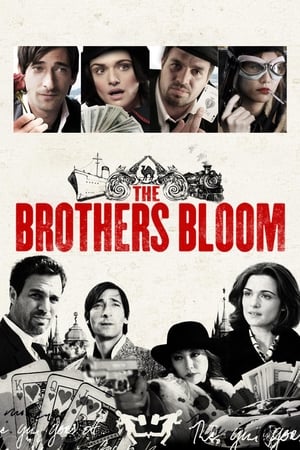
THE BROTHERS BLOOM(2008)
Written by: Rian Johnson
Genre: Drama
Title: The Brothers Bloom
Written by: Rian Johnson
Draft date: Not specified
LOGLINE
Two orphaned brothers who have been running elaborate cons since childhood face their most personal scheme yet when the elder brother devises a plan to swindle a lonely, eccentric heiress — but the younger brother, desperate for an authentic life, falls in love with their mark and must decide whether anything in his world is real.
| Very Poor | Poor | Fair | Good | Excellent | |
|---|---|---|---|---|---|
| PREMISE | ✓ | ||||
| STRUCTURE | ✓ | ||||
| CHARACTER | ✓ | ||||
| CONFLICT | ✓ | ||||
| DIALOGUE | ✓ | ||||
| PACING | ✓ | ||||
| TONE | ✓ | ||||
| ORIGINALITY | ✓ | ||||
| LOGIC | ✓ | ||||
| CRAFT | ✓ |
| Strong Pass | Pass | Consider | Recommend | Strong Recommend | |
|---|---|---|---|---|---|
| Overall | ✓ |
Genre: Comedy, Drama
Sub-genre: Caper Comedy, Romantic Drama, Adventure Comedy
Keywords: Con Artists, Brothers, Ensemble Cast, Globe-Trotting, Foreign Locale, Redemption, Romance, Heist, Mentor-Protégé, Fish-Out-Of-Water, Eccentric Characters, Trust, Identity, Male Protagonist
MPA Rating: R (pervasive strong language, some violence including gunfire and explosions, brief sexual content, implied child abuse)
Budget Tier: Medium ($10M–$40M) — multiple international locations (Berlin, Italy, New Jersey, Greece, Prague, Hungary, Mexico, Tokyo, St. Petersburg), period-appropriate vehicles, several explosions and action sequences, a steamer ship, moderate cast size, castle exteriors/interiors
Pages: 122
Time Period: Present, spanning approximately 6-9 months of primary action with a prologue set 25 years earlier
Locations: Approximately 15% small-town America (prologue), 10% Berlin, 10% Northern Italian coast/church island, 10% New Jersey mansion, 10% aboard a steamer ship, 15% Prague (hotel, castle, streets, Curator's apartment), 5% Hungarian train, 10% Mexico beach/hotel, 15% St. Petersburg (streets, apartments, burned-out theater, highway). Requires a cherry red Lamborghini (multiple), a steamer ship, a castle exterior with an explosion blowing out a tower section, a car explosion, a train interior, and multiple European street exteriors.
Lead: Male, 35, race unspecified, melancholy and introspective con artist trapped between his desire for authenticity and his brother's elaborate fictions — physically slim enough to be launched off a bicycle, emotionally guarded but yearning.
Comparables: The Sting (elaborate long-con mechanics and period-flavored caper structure), Wes Anderson's The Royal Tenenbaums (stylized narration, eccentric family dynamics, melancholy beneath whimsy), Dirty Rotten Scoundrels (globe-trotting con artist comedy with a female mark who proves more resourceful than expected), Amélie (a lonely, quirky protagonist finding connection through adventure and imagination).
SYNOPSIS
In an unnamed American small town, two foster brothers — STEPHEN (13), the elder schemer, and BLOOM (10), the shy younger sibling — arrive at their thirty-eighth foster home. Stephen devises an elaborate fifteen-step con targeting the local children: Bloom befriends them, tells them a tale of a hermit guarding a cave of wonders, and collects thirty dollars to learn its location. On Sunday, the children chase a will-o'-the-wisp through a cave (actually Stephen with a flashlight), while Bloom — genuinely enchanted — briefly forgets the con is fake. The children's parents discover the scheme, the brothers are returned to welfare, but Stephen has also negotiated a dry-cleaning percentage deal, and they leave with Rocket Pops and a calling.
Twenty-five years later in Berlin, the Brothers Bloom complete an elaborate con on CHARLESTON (40s), an investment banker manipulated into shooting "Victor" (actually Bloom in a blood-rigged suit) in a burning library. Their silent associate BANG BANG (early 20s), a Japanese explosives expert who speaks roughly three words of English, assists. At a celebratory bar, Bloom broods in a booth while ROSE, a woman in scarlet, tries to kiss him. Bloom explains how Stephen engineers every emotional beat of their cons — matching costumes and words to Charleston's ex-wife — and declares he wants out. In Berlin's Tiergarten, Bloom tells Stephen he wants "an unwritten life" and departs.
Three months later, Stephen finds Bloom drinking on a tiny Italian island church. He lures Bloom to New Jersey to meet their "final mark": PENELOPE STAMP (early 30s), a wealthy, eccentric shut-in who has spent her life collecting hobbies — piano, skateboarding, karate, origami, pinhole photography — after being misdiagnosed with universal allergies and confined indoors while caring for her dying mother. Bloom protests Stephen's violation of their rule against targeting women, but agrees to one last con. He crashes a bicycle into Penelope's Lamborghini, landing in the hospital. Penelope, who suffers an epileptic seizure during the crash, invites him home for coffee. Through an awkward but genuine conversation about her pinhole cameras, they connect.
Penelope follows Bloom to a steamer ship bound for Greece, where she meets Stephen and Bang Bang (introduced as "Mrs. Yuengling," Stephen's secretary). Aboard the ship, THE CURATOR (Maxmillion Melville), a large Belgian museum curator in a fur-collared cape, reveals himself as an acquaintance who knows the brothers are smugglers, not antique dealers. Penelope shares her life story over cards on the moonlit deck. In Greece, Penelope reveals the Curator offered to sell her a stolen eighth-century Book of Hours from Prague's National Museum for one million dollars — to be resold to a dying Argentinian for two and a half million. When the Curator absconds with Penelope's certified check, she insists on breaking into Prague Castle to steal the book herself.
Bang Bang accidentally detonates the full brick of nitroglycerin instead of a small charge, blowing a massive hole in the castle's eastern tower. Penelope proceeds anyway — burning a guard's lips with his own cigar, crawling through ventilation ducts, and getting caught by soldiers — but somehow talks her way free, emerging with the book and a police escort. Meanwhile, the DIAMOND DOG, Stephen and Bloom's sinister former mentor, appears in Prague. Bloom confronts him at a hotel bar in a tense scene laced with implied past abuse. Stephen arrives and slashes the Dog's hand with a broken bottle.
Stephen proposes the final phase: they will travel to St. Petersburg, sell the book through a fake Russian mob setup using the Diamond Dog's crew, then stage a violent ambush in which Stephen and Bloom appear to die — freeing Penelope to live adventurously while believing Bloom died protecting her. In Mexico, Bloom confesses the entire con to Penelope, then confronts Stephen at the beach house. The brothers fight savagely until Bang Bang's pistol falls and discharges, apparently shooting Stephen. Penelope flees in grief. Stephen reveals the wound is fake — squibs and blood packets — and sends Bloom away.
Three months later, Penelope blows up her mansion and finds Bloom on his Italian island. She presents her plan: "Penelope the Con Artist." Bloom, unable to resist and unwilling to lose her, calls Stephen and hatches a new scheme — one last con designed solely to blow Penelope off permanently, to protect her. In Tokyo, they reunite with Bang Bang. Stephen's plan: sell the Book of Hours to fake Russians in St. Petersburg, then stage an escalating series of deaths — Stephen, Bang Bang, Bloom — so Penelope escapes believing the Russian mob killed everyone she loved.
In St. Petersburg, Penelope sells the book — but to real Russians, because the Diamond Dog has been murdered and his operation seized. The attack on their car is genuine. Stephen is dragged away by a dark figure. Bang Bang departs with a suitcase and a Japanese farewell note before her car explodes. Bloom and Penelope receive a ransom demand for Stephen — exactly $1.75 million, the amount Stephen planned to take. Bloom cannot tell if this is the ultimate con or reality. Penelope wires the money. Bloom enters a burned-out theater and finds Stephen tied to a chair, beaten. In the darkness, a gunman fires. Stephen tackles Bloom to safety and is shot in the lower back. Stephen then appears to reveal it was all a con — he stands, grins, calls for a "wow." He and Bloom embrace. Stephen sends Bloom away with Penelope, telling him to play it as though Stephen died.
Driving toward Finland, Bloom notices the blood on his cuff has turned brown — real blood turns brown, fake blood does not. He forces Penelope to stop, examines the charred money from the Peugeot, and finds the bills are genuine — no misprints. The Diamond Dog was already dead. The Russians were real. Stephen truly saved Bloom's life and is gone. Penelope holds Bloom's face and tells him Stephen said there is no such thing as an unwritten life, only badly written ones. She declares they will outrun the Russians and live the best story in the world. Bloom takes her hand and runs toward the light breaking over the hill. The VW chugs toward the sunset.
COMMENTS
PREMISE — Excellent
The premise operates on a compelling paradox: a con man who longs for authenticity is trapped inside a life where every relationship, including his most intimate ones, is authored by someone else. This tension between the written and the unwritten life gives the material a philosophical engine that elevates it above standard caper fare. Stephen and Bloom form a fascinating dyad — the architect who can only experience life through his fictions, and the performer who can only experience life through his brother's fictions — and Penelope introduces a third possibility: someone who genuinely chose to narrate her own existence without victimizing anyone. The globe-trotting, tonally playful surface (comparable to The Sting crossed with Wes Anderson's sensibility) provides consistent entertainment value, while the deeper question — whether a story told well enough becomes indistinguishable from reality — gives the material thematic weight. The central dramatic question sustains itself across the full page count: will Bloom ever live a moment that is not a con? The premise is rich, pitchable, and emotionally grounded.
STRUCTURE — Good
The prologue functions as an elegant thesis statement, establishing in miniature every thematic and structural pattern the narrative will revisit: Bloom performs Stephen's role, falls for the girl, and is left behind when the fiction ends. The transition to the Berlin con (14) efficiently reintroduces the brothers as adults and establishes the status quo. Bloom's declaration that he wants out (23-24) and Stephen's pursuit to Italy (25-27) form a clean catalyst-to-commitment sequence. The midpoint pivot — the Curator absconding and Penelope deciding to break into the castle herself (71-73) — lands proportionally and shifts Penelope from passive mark to active agent. The Mexico sequence (85-91) functions as a false climax that mirrors the prologue's structure: Bloom reveals the con, fights for the girl, and is left behind again. The St. Petersburg finale (99-122) then replays the pattern a final time with lethal stakes. This tripartite repetition-with-escalation is the architecture's greatest strength, but it also creates a structural sag in the second half: the Tokyo interlude (96-98) and the setup for the Russian con involve considerable exposition that slows momentum between Mexico and the climax. The final revelation — real blood turning brown (119-120) — is a superb plant-and-payoff rooted in a throwaway line from page 23.
CHARACTER — Good
Bloom is defined by a specific and poignant wound: he has never lived a moment that was not scripted by his brother, and he does not know whether his own emotions are genuine or performed. This is established viscerally in the cave scene when he forgets himself and chases the light before seeing Stephen behind the curtain (11), and it recurs with elegant precision when Stephen literally writes Bloom's "unwritten life" line for him (24). His arc — from paralysis to choosing Penelope and an uncertain future — completes itself on the final page. Stephen is the more complex figure: his goals are layered (protect Bloom, perfect his art, possibly sacrifice himself), and the ambiguity of his final actions elevates him from supporting player to co-protagonist. Penelope enters as a potential cipher but quickly becomes the most alive character on the page — her hobby montage (37), her pinhole camera philosophy (38), and her drunk thunderstorm scene (59-60) establish her as someone who has already done the internal work Bloom cannot. The Diamond Dog (67-68) is drawn with economic menace, his implied predatory history communicated through physical details rather than exposition. Bang Bang's near-silence is a risky choice that mostly works, though her emotional farewell — a Japanese tattoo, a karaoke song, a car bomb — relies heavily on the audience investing in a character who has been given very little interiority.
CONFLICT — Fair
The central conflict is internal — Bloom's inability to distinguish his genuine feelings from the role Stephen has written for him — and it is externalized through a series of escalating cons that force the question with increasing urgency. The first con (children's cave) costs Bloom a girl. The Penelope con costs him love. The final con may have cost him his brother's life. This escalation is effective because the stakes are emotional rather than merely financial, and because each iteration adds a new variable: in the cave, Bloom is a child with no agency. With Penelope, he has agency but cannot trust it. In St. Petersburg, he has both agency and genuine danger, and must act without Stephen's script. Scene-level conflict is generally strong — the castle break-in sequence (76-82) sustains tension through multiple reversals — but the conflict between Bloom and Stephen sometimes resolves too easily in conversation. Their Tiergarten argument (23-24) and their Mexico confrontation (89-91) both escalate to genuine emotional violence, but the intervening stretches often find them in comfortable accord, which diminishes the friction that should be constant between a controlling author and his reluctant character.
DIALOGUE — Good
The dialogue carries a distinctive literary register — heightened, rhythmic, sometimes self-consciously clever — that suits the material's fairy-tale framing but occasionally crosses into preciousness. Stephen's voice is the sharpest: "Wahk wahk wahk wahk wahk wahk wahk. Score to beat is 7.9" (31) and "I was writing in a bar" (42) are character-specific lines no one else could deliver. Bloom's voice is more diffuse — his long speeches tend toward articulate self-analysis ("I've only ever lived life through these roles that aren't me," 24) that sounds more like theme than character. Penelope's dialogue is the most naturalistic and surprising: "You've got a big load of grumpy petrified poop up your soul's ass" (59) and her drunken manifesto on the train are genuinely distinctive. The Narrator's verse (2-14) establishes tone efficiently but disappears entirely after the prologue, which creates a slight formal inconsistency. The Diamond Dog's dialogue (67-68) achieves menace through specificity — "the murky backwaters of my children's psyches" — but his scene is the only one where subtext fully replaces text, making it the strongest dialogue sequence in the material.
PACING — Fair
The first forty pages move with exceptional efficiency, compressing the prologue, the Berlin con, the Italian reunion, and Penelope's introduction into a propulsive sequence that never lingers. The steamer ship section (41-55) begins to decelerate as exposition about the Curator's scheme and backstory accumulates, though individual scenes (the moonlit bolero, the deck breakfast with the Curator) remain engaging. The Prague castle heist (73-82) is the pacing high point — a setpiece that escalates through five distinct reversals in nine pages. The Mexico sequence (84-92) sustains tension well through the confession and fight, but the three-month time jump and Italy reunion that follows (92-96) slows the narrative significantly just as it should be accelerating toward its climax. The Tokyo and St. Petersburg setup scenes (96-103) involve substantial logistical dialogue — who plays the Russians, where the charges go, which bridge to cross — that bogs down the final act's momentum before the genuine attack re-energizes everything. The theater sequence (114-118) and the roadside revelation (119-122) are paced beautifully, delivering the emotional climax with appropriate weight.
TONE — Good
The material walks a high wire between fairy-tale whimsy and genuine emotional pain, and it mostly maintains balance. The narrated prologue (2-14) establishes the storybook register, the Berlin con (14-17) introduces sharp adult wit, and the shifts between modes are managed through consistent visual and verbal motifs — playing cards, Rocket Pops, the green rubber band money. The Curator's golem tale (63-65) represents the most dramatic tonal shift, plunging from caper comedy into genuine grief, and it works because the material has earned permission through smaller tonal modulations (the Diamond Dog's menace, Bloom's quiet despair). The Diamond Dog's scene at the hotel bar (67-68) introduces implications of child sexual abuse that sit uncomfortably against the surrounding whimsy — this is intentional and effective, but the scene's horror dissipates quickly when Stephen arrives with a broken bottle, and the material never fully reckons with what was implied. Bang Bang's car explosion (107) asks for genuine grief immediately after a comic "call me" gesture, and the tonal whiplash there is less controlled than elsewhere.
ORIGINALITY — Excellent
The con-man genre is well-populated — The Sting, Dirty Rotten Scoundrels, Matchstick Men, Ocean's Eleven — and the material is openly aware of its lineage, naming the ship after Melville's The Confidence-Man and structuring cons with literary self-consciousness. What distinguishes this from its predecessors is the meta-fictional layer: the central conflict is not whether the con will succeed but whether anything in the protagonist's life — including his own emotions — is authored rather than authentic. This is a question more commonly associated with Charlie Kaufman's work (Adaptation, Synecdoche, New York) than with caper films, and the fusion of those sensibilities is genuinely novel. The structural device of repeating the same pattern (Bloom performs, falls for the girl, loses her) three times with escalating consequences is elegant. Penelope — a shut-in who has already solved the protagonist's existential crisis through sheer force of will — is a fresh construction of the "mark" archetype. The ending's ambiguity (did Stephen plan his own death, or did reality overwhelm his fiction?) has no clean precedent in the genre.
LOGIC — Fair
The central mystery — whether Stephen orchestrated the final events or was overtaken by them — is designed to be ambiguous, and the clues are planted with precision: the brown blood (23, 119), the cross-hatched money (100, 120), the Dog's disappearance, the boy alone in the apartment. However, several plot mechanics strain credibility. The Curator's departure from Prague (70-71) — fleeing with Penelope's million but leaving the valuable book behind in an accessible crawlspace — is convenient rather than logical, even if the explanation is that the book is a planted fake. Penelope's ability to talk her way out of arrest by Prague's chief of police after being caught in a kung-fu stance during a terrorism investigation (81-82) is treated as a charming mystery, but it requires the audience to accept an enormous narrative gap on faith. The bomb mix-up (77-78) — Penelope placing the dynamite in Bang Bang's backpack instead of the petri dish in the handbag — is set up on page 75, but Bang Bang's failure to notice she is detonating the wrong device strains the established characterization of someone who is "an artist with nitroglycerin" (73).
CRAFT — Good
The writing operates at a high level of formal ambition, blending verse narration, visual storytelling, and voiceover with confidence. Character introductions are vivid and efficient: the one-legged cat on a roller skate (3), Penelope emerging from a dust cloud after crashing a Lamborghini (28), Bang Bang saying "no" with a look (19). Action description is economical and image-driven — "Dawn with her rose-red fingers" (2) and "sunset with her wine-red fingers" (123) bookend the narrative with Homeric allusion that earns its literary register. The recurring motifs (playing cards, the green rubber band money, the phrase "tastes like tin foil") are planted and paid off with satisfying precision. Formatting is clean throughout, with one notable exception: the simultaneous dialogue blocks during the Curator's shotgun scene (62) are correctly formatted but create a brief reading stumble. The hobby montage (37) is presented as a list rather than described action, which is an unusual formatting choice that works because it mirrors Penelope's matter-of-fact relationship with her own talents. Occasional typos appear — "Charelston" (21) for "Charleston," "Yeungling" and "Yuengling" used interchangeably — but these are minor.
OVERALL — Recommend
The Brothers Bloom is a globe-trotting caper comedy about two con-artist brothers whose final scheme — targeting a lonely heiress — forces the younger brother to confront whether he has ever experienced a genuine emotion. Its strongest categories are Premise, Character, and Originality: the central paradox is rich and sustaining, the three leads are vividly differentiated, and the meta-fictional layer distinguishes it from the genre's well-known predecessors. The craft is polished and formally ambitious, with recurring motifs and plant-payoffs that demonstrate structural command. The weakest categories are Pacing and Logic: the second half introduces expository stretches that slow momentum between the Prague and St. Petersburg setpieces, and several plot mechanics — particularly Penelope's magical escape from Prague Castle and the bomb mix-up — rely on audience goodwill rather than internal consistency. The material's tonal high-wire act is largely successful but wobbles at the Diamond Dog scene, where implications of abuse are raised and then quickly set aside. The ending achieves genuine emotional power through the brown-blood revelation, converting what appeared to be a clever twist into a devastating realization about the cost of Stephen's art.
Get this level of coverage for your screenplay
Every coverage includes 10 category ratings, an overall recommendation, and detailed analysis — powered by the same methodology used by talent agencies and literary managers.
Movie data provided by TMDB